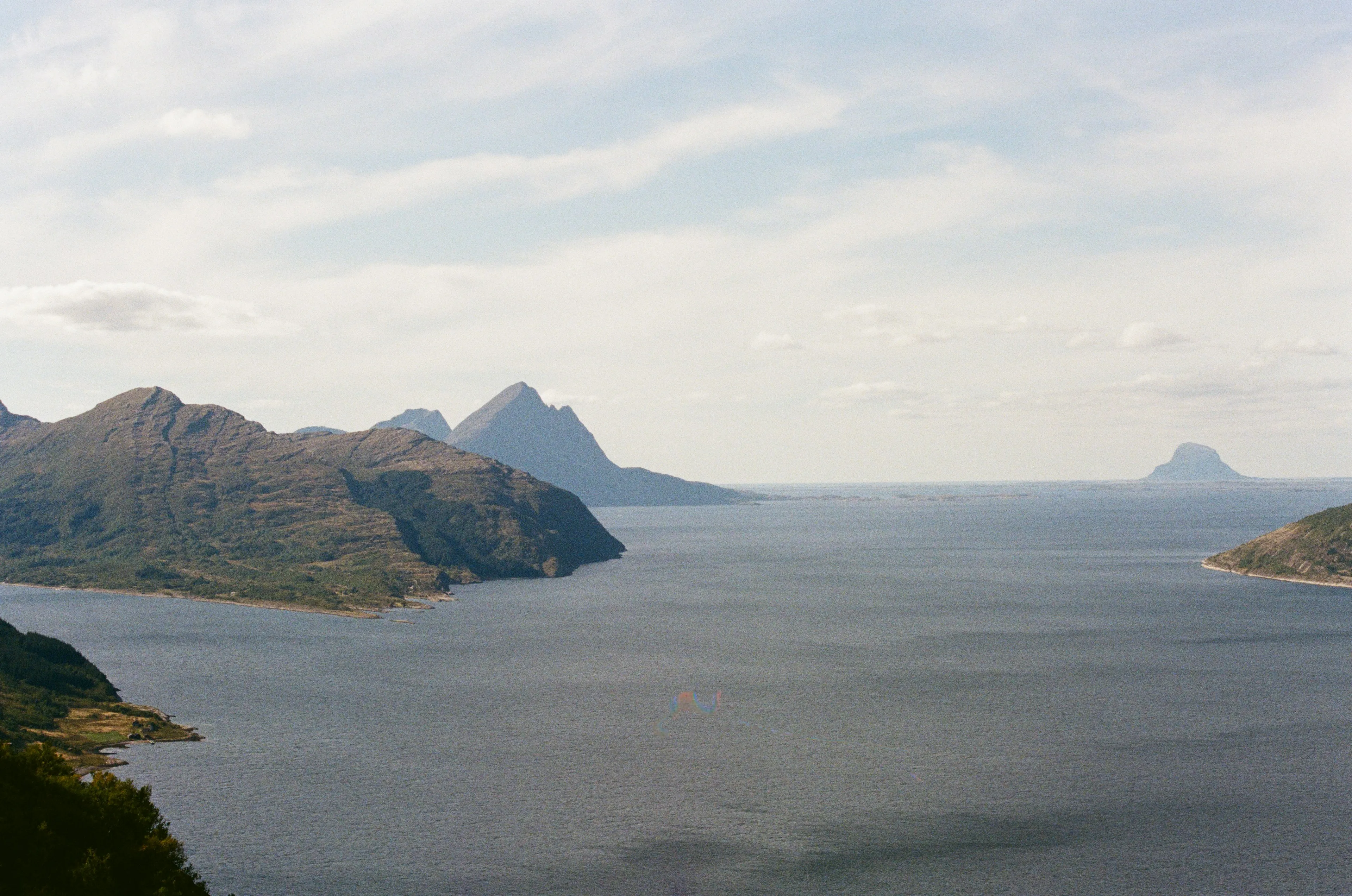
The best time to charter a yacht in the western fjords of Norway is from late May to early September, and within that window the choice is between light and warmth. May and June are the driest and brightest months, with daylight lasting 17 to 19 hours around Bergen. July and August are the warmest, in the air and in the water, and the busiest. In the Arctic north there are two separate seasons: the midnight sun from late May to late July, and the northern lights from roughly September to March. You have to choose between them.
In most charter destinations the question is when the sea is warm enough. In Norway it never really is, and the sea is not the point. What changes most through the year is how many hours of light you have to live in, and that is the thing to plan around. This guide sets out the numbers, month by month, so you can choose the voyage that suits you. Our Norway destination page describes the place itself.
Daylight through the year
Norway is long. Bergen, the gateway to the western fjords, sits at about 60 degrees north. Tromsø, the base for most Arctic voyages, is nearly ten degrees further north and well inside the Arctic Circle. The table shows average day length, sunrise to sunset, for each.
| Month | Bergen (western fjords) | Tromsø (Arctic north) |
|---|---|---|
| January | 6 h 50 min | 1 h 50 min |
| February | 9 h 10 min | 7 h 25 min |
| March | 11 h 55 min | 11 h 50 min |
| April | 14 h 40 min | 16 h 20 min |
| May | 17 h 25 min | 22 h 10 min |
| June | 18 h 55 min | 24 h |
| July | 18 h 00 min | 23 h 35 min |
| August | 15 h 30 min | 18 h 00 min |
| September | 12 h 50 min | 13 h 20 min |
| October | 10 h 00 min | 8 h 55 min |
| November | 7 h 25 min | 3 h 30 min |
| December | 5 h 55 min | 0 h |
Three things stand out. First, even in Bergen the sun is up for almost 19 hours in June, and the twilight that follows never becomes proper darkness. Second, the two places are nearly identical in March and September, around the equinoxes, and diverge sharply either side. Third, the change is fast. Tromsø gains almost six hours of daylight between April and May, and loses about as much between July and August.
Midnight sun and polar night
North of the Arctic Circle the sun does not set at all for a period in summer. Visit Norway gives these dates:
| Place | Midnight sun |
|---|---|
| Bodø | 4 June to 8 July |
| Lofoten Islands | 28 May to 14 July |
| Tromsø | 20 May to 22 July |
| North Cape | 14 May to 29 July |
The further north you go, the longer it lasts. The mirror image is the polar night, when the sun does not rise. In Tromsø this runs from about 28 November to 14 January. It is not total darkness, as there are a few hours of twilight around midday, but it is not a time for a conventional charter. Bergen and the western fjords lie well south of the Arctic Circle and have neither.
Northern lights or midnight sun: you cannot have both
The aurora needs a dark sky, and the Arctic summer does not have one. In Tromsø no aurora is visible from late April to mid August. Visit Norway puts the northern lights season from late August to late March, and notes that activity is statistically highest around the equinoxes, in September and October and again in March.
So the two great spectacles of northern Norway fall in opposite halves of the year:
- Late May to late July: continuous daylight, the mildest air, hiking and paddling at midnight. No aurora.
- September to March: dark skies and a chance of the lights. Short days, cold, and from late November no sun at all in Tromsø.
September is the nearest thing to a compromise. Tromsø still has more than 13 hours of daylight and an average daytime high of about 11°C, and the nights are dark again. Cloud is the caveat: the coast is often overcast, and an aurora you cannot see is no use to anyone. No one can promise you the lights on a given week.
Air and sea temperatures
Norway’s coast is mild for its latitude but it is not warm. The figures below are the 1991 to 2020 normals for Bergen, with typical sea surface temperatures for the coast there.
| Month | Daytime high, Bergen | Sea, Bergen | Rainfall, Bergen |
|---|---|---|---|
| May | 15°C | 8.5°C | 109 mm |
| June | 18°C | 11.5°C | 132 mm |
| July | 20°C | 14°C | 158 mm |
| August | 19°C | 15°C | 208 mm |
| September | 16°C | 13.5°C | 248 mm |
In Tromsø the July high averages about 16°C and the sea peaks at around 11.5°C in August. In March and April it is down to about 4.5°C.
These are averages. Charter brokers note that midsummer days can reach the low 20s and that the surface water in some sheltered fjords gets warmer than the open coast. Even so, a swim here is a cold-water swim, taken on purpose and usually followed by a sauna or a hot tub on deck. If warm-water swimming is central to your idea of a voyage, look at Sardinia or Croatia instead. If a short, sharp plunge before breakfast appeals, Norway is very good at it.
Rain on the west coast
Bergen is often described as the rainiest city in Europe. The 1991 to 2020 normal is about 2,495 mm of precipitation a year, falling on roughly 200 days. The cause is the landscape: wet Atlantic air meets the mountains, rises and drops its rain.
What matters for planning is that the rain is not evenly spread. May is the driest month at about 109 mm, and April to July are all markedly drier than the rest of the year. From August the totals climb quickly, to about 248 mm in September and around 270 to 290 mm a month from October to December. May is also the sunniest month in the Bergen record we used, with roughly 250 hours of sunshine.
Tromsø, perhaps surprisingly, is much drier, at a little over 1,000 mm a year, and May and June are its driest months too.
Two practical notes. Expect some rain and some fog in any week, whatever the month, and pack for it; our packing guide covers layering. And rain is not a loss here. The waterfalls run harder and cloud hanging in a fjord is part of what people come for.
How sheltered the fjords are
A fjord is a long, deep, narrow arm of the sea, often reaching far inland. The two World Heritage areas, Geirangerfjord and Nærøyfjord, lie about 60 and 100 kilometres from the open coast. Ocean swell does not reach that far, and the water at anchor is typically flat. For guests who worry about motion, this is some of the most settled cruising in Europe.
Much of the coast between the fjords is also protected, by a belt of islands and skerries that allows a yacht to travel on an inside route. There are gaps. Hustadvika, in Møre og Romsdal, and the headland of Stad are open to the Norwegian Sea, and cruising accounts describe Hustadvika as an exposed area best avoided in unfavourable conditions. A captain will time these stretches for a quiet morning or wait a day.
Sheltered does not mean windless. Steep walls funnel the wind and can send sudden gusts down onto the water; one summer passage account in Yachting Monthly records a 30 knot gust rolling off the cliffs, and strong tidal effects where a fjord meets the ocean. The same account includes three nights spent waiting out bad weather in the middle of the season. Build slack into the itinerary.
The charter seasons
Western fjords, late May to early September. This is the main season, with late June to August the peak. The season is short and far fewer charter yachts work here than in the Mediterranean, so it pays to plan early.
Arctic north in summer, late May to July. Lofoten, Tromsø and the coast between, under the midnight sun.
Arctic north in winter and spring. A different kind of voyage, on expedition yachts built for it, based around Tromsø and the Lyngen Alps. Brokers describe skiing down to the yacht in early spring or autumn with a chance of the aurora overhead. It is cold, active and weather-dependent.
Cruise ships and the World Heritage fjords
The famous fjords are not empty in summer. The Norwegian Coastal Administration counted 3,654 cruise calls in Norway in 2024, carrying 5.9 million passengers. June had the most calls (728), closely followed by July (721). January had 62. Geiranger and Hellesylt, the two ports on Geirangerfjord, received just over 510,000 day cruise passengers that year. By overall visitor numbers the administration ranked Geiranger and Hellesylt second in the country, behind Bergen, with Flåm, the port for the Nærøyfjord area, fourth.
Regulation is changing the picture. Norway has adopted a zero-emission requirement for passenger ships in the World Heritage fjords. According to the Norwegian Maritime Authority, it has applied to passenger ships under 10,000 gross tonnage since 1 January 2026 and will apply to larger ships from 1 January 2032. Biogas is permitted as an alternative under set conditions, and shore power must be used where it is available. How the rule applies to a particular charter yacht depends on how that vessel is classed, and the detail may change, so your broker and captain will confirm the current position before an itinerary includes these fjords.
A private yacht has an advantage either way. It can enter a headline fjord in the evening, after the day ships have gone, or early in the morning before they arrive. And it can go to the many fjords that large ships do not visit at all.
Which months suit which voyage
For quiet and restoration: late May, early June and early September. Late May and early June give long light, the lowest rainfall of the year and often snow still on the high ground, before cruise traffic reaches its peak. Early September is quieter still, with a sea that is nearly as warm as August, at the price of more rain. The light nights of early summer do not suit everyone. If you sleep lightly, ask about blackout blinds in the cabins; our guide to sleep at sea has more on rest aboard.
For active wellness: June to August. The air is at its warmest, the sea is at its least cold for kayaking, paddleboarding and swimming, and 18 hours or more of daylight means a long hike never has to be hurried. This is the season our active wellness voyages in Norway are built around. For skiing from the yacht, the season is early spring in the far north.
For a team or leadership retreat: June or early September. Long light gives a group room for both working sessions and time outdoors, and a fjord has few distractions. September adds lower crowding and, in the north, a chance of the aurora. See our corporate retreat page and the guide to planning a corporate retreat at sea.
Months to avoid for a first visit: October to April in the western fjords. It is wet, the days are short and few charter yachts are in the country. The exception is a purpose-planned Arctic voyage for the aurora or the snow.
How we rate calm
The calm rating in the month table, from 1 to 5, is our editorial reading of typical wind and sea state for a guest at anchor and under way. It is not a forecast. For Norway it describes the western fjords and the sheltered inside route, not the open coast, which is rougher in every month. We rate summer at 4 because fjord water is flat but gusts and unsettled spells do occur, and winter at 2 because Atlantic storms are frequent and the exposed passages between fjords are often rough. The crowd rating reflects the national pattern of cruise calls and refers to the popular fjords; quieter ones are quiet all year.
The air and sea temperatures in the month table refer to Bergen. Air temperatures are the average daily maximum from the 1991 to 2020 normals for the Florida weather station. Tromsø and the north are several degrees colder throughout.
If you are still weighing Norway against somewhere warmer, the Voyage Designer is a gentle way to think it through.
Weather in Norway varies a great deal from year to year and from one fjord to the next, and regulations for the World Heritage fjords are still evolving. Treat these figures as typical, not promised, and tell us what you have in mind so we can check current conditions and rules for your dates.