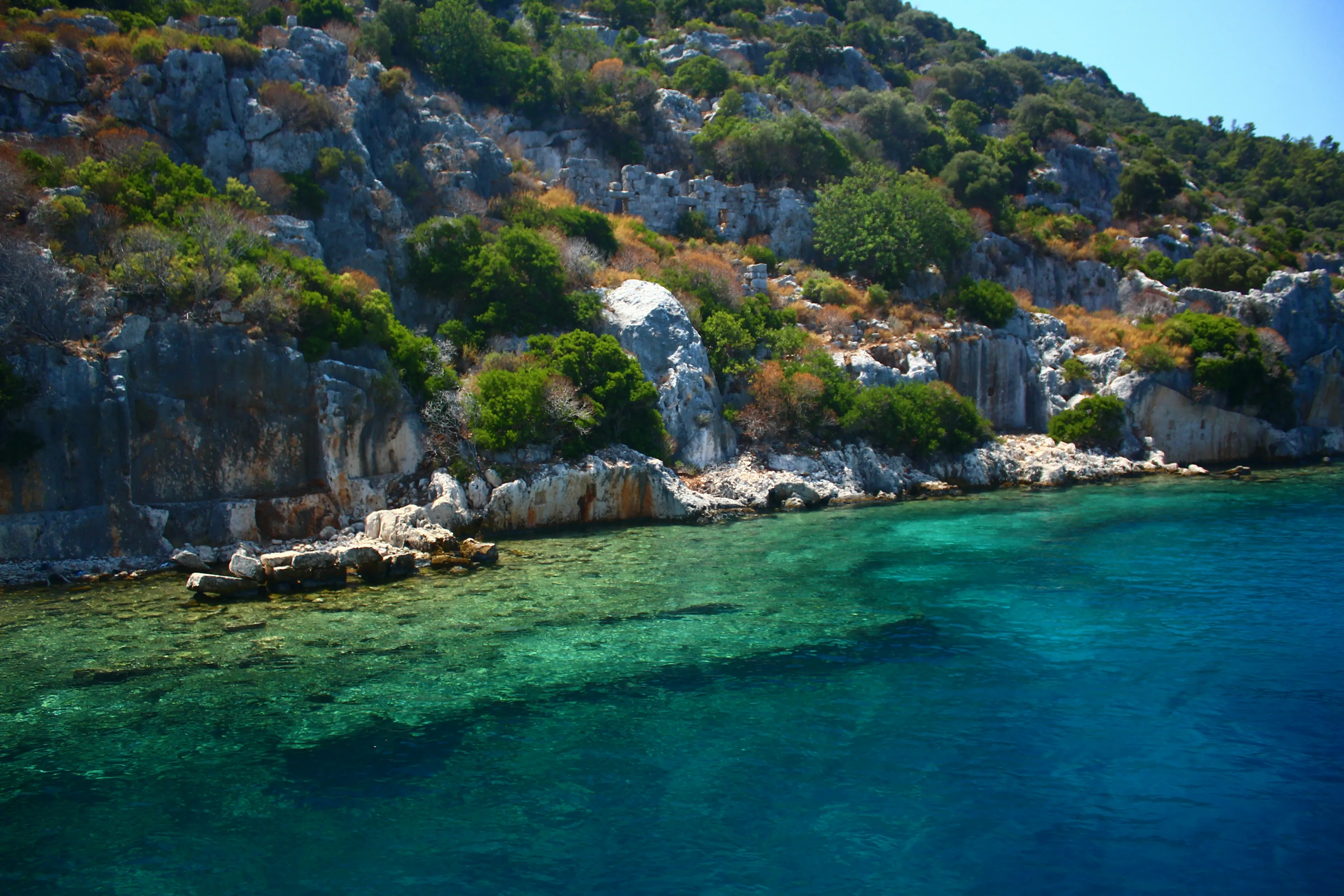
Turkey’s south-west coast is calmest and quietest in late May, June, September and the first half of October. September is the month we would choose first: the sea at Marmaris still averages about 27C, rain is rare, the summer wind is losing its strength and the crowds of July and August have gone home. High summer is reliably dry and the sheltered gulfs stay comfortable, but average daytime highs reach 35C, the afternoon wind is at its strongest and the popular bays are full.
This guide covers conditions only: wind, water, heat and crowding, month by month and area by area. For what to do once you are there, from thermal springs to the hammam and the food, see our wellness guide to the Turquoise Coast.
How the meltemi reaches Turkey
The wind that defines an Aegean summer is the meltemi, a dry northerly that forms between high pressure over the Balkans and a heat low over Anatolia. Sailing Issues, a long-running pilotage site, puts about 70 per cent of its occurrence between June and September, with the peak in July and August and some activity in May and October. In the open Aegean it typically arrives in the early afternoon at Force 4 to 5 (11 to 21 knots), not uncommonly reaches Force 5 to 7, and can blow for three to six days at a stretch. Our Greek Islands month-by-month guide covers that side of it.
Turkey sits at the downwind, sheltered end of the system. Yachting World’s cruising correspondent Annabel Finding describes the meltemi as “far less strong along the Turkish coast” than among the Greek islands, and Yachting.com’s pilotage notes give its normal strength here as Force 2 to 4, roughly 4 to 16 knots, with occasional gusts to about Force 7. The wind bends as it meets the land, following the coast and running into the long gulfs from the west.
The weather stations tell the same story in miniature. On the 1991 to 2020 normals, July’s mean wind speed is 3.9 metres per second (about 8 knots) at Datca, out on its exposed peninsula, 2.7 at Bodrum, 2.5 at Marmaris and just 1.5 (about 3 knots) at Fethiye. These are all-hours averages from stations on land, so they read well below an afternoon breeze on open water, but the ranking is the useful part: wind falls away steadily as you move south and east into the gulfs.
The daily rhythm
Summer wind here keeps hours. Mornings are usually light or calm. The breeze fills in from late morning or early afternoon, is strongest through the afternoon, and drops in the evening, which, as Finding puts it, allows “a comfortable night at anchor”. She adds one caution: gusts can fall off the steep mountainsides after dark, which is why captains choose their overnight bays with care.
For a guest this shapes the day neatly. The flat water between dawn and about eleven is for swimming, paddleboarding and anything done on a mat. The afternoon breeze cools the deck and suits a passage under way. Occasionally, in a strong spell, the meltemi does not die at sunset and blows through the night; those are the days a crew tucks further into a gulf.
How the coast divides
The cruising ground runs from the Bodrum peninsula south and east to Kekova, and the areas along it behave differently.
| Area | Wind and water | Crowding in high summer | Suits |
|---|---|---|---|
| Bodrum and the Gulf of Gokova | The meltemi funnels down the gulf in the afternoon; calm mornings, protected anchorages | Bodrum is the busiest base; the gulf’s bays thin out with distance | Livelier afternoon sailing, June and September |
| Datca and the Hisaronu gulf | The most exposed corner: Datca is the windiest of the stations we checked. Deep inlets give shelter | Quieter than either neighbour | Active voyages that welcome a breeze |
| Marmaris | Enclosed bay, light winds, very hot in July and August | Large resort and charter base; busy | Starting and ending a voyage |
| Gulf of Fethiye and Gocek | The most sheltered water on the coast; lightest winds | Very busy; the bays are now managed by reservation | Stillness, first-time guests, families |
| Lycian coast to Kas and Kekova | Longer open-coast passages, then sheltered water behind Kekova island | Thinner; little road access to many bays | Longer, quieter voyages in May, June, September |
The first two rows rest on the station winds above and on operator pilotage notes for Gokova, which describe an almost enclosed gulf where the meltemi usually builds in the afternoon and mornings are calm enough for swimming. The Fethiye row rests on the same normals: Fethiye’s mean wind is the lowest of the four stations with wind records in every month of the year. The Lycian coast is a degree or two cooler in summer than the gulfs, with average highs of 32.5C in July and 32.9C in August at Kas against 35C at Marmaris. Our reading of the passages between Fethiye and Kas as more exposed is a matter of geography, not measurement: there are fewer inlets on that stretch, so a captain picks the day.
Sea temperature and the long autumn
We use Marmaris as the reference, from NOAA satellite readings published by SeaTemperature.org. The sea is coldest in February at about 16.6C, reaches 20C in May and about 24C in June, and peaks in August at 27 to 28C. Then it cools slowly: about 27C in September, 24C in October and still 21C in November.
That slow decline is what makes autumn here. Water stores far more heat than air and gives it up reluctantly, so the sea lags the season by a month or more. October’s average daytime high at Marmaris is 26.5C, almost identical to May’s 26.4C, but the October sea is nearly four degrees warmer. Even the November sea is warmer than May’s. The working charter season runs from April to the end of October, and Yachting World places the main season from June to September.
Summer heat
Heat is the wellness consideration that brochures leave out. Average daily highs at Marmaris are 34.9C in July and 35.0C in August, and Bodrum and Fethiye are within half a degree of that. These are averages, so many afternoons are hotter. Rain is close to absent, under 6 mm in July at Marmaris, and July brings about 11 hours of sunshine a day.
On a yacht this is easier than ashore, because the sea is always a step away and the afternoon breeze does real work. It still changes the shape of a restorative week. Movement belongs at dawn, walks ashore and visits to ruins before ten or after five, and the middle of the day in the shade or the water. Guests who sleep poorly in heat, or who want long walks on the Lycian hills, will be happier in a month when highs are in the mid to high 20s: May or October. Our piece on sleep at sea explains why cooler nights matter.
December to March
The off season. Winters at Marmaris are very wet, with about 289 mm of rain in December and 256 mm in January, falling on 11 days of each month. Winds are at their highest of the year at Bodrum and Datca, daytime highs sit between 15 and 18C and the sea falls to 17C. Winter weather arrives in fronts with fine, clear days between them, and most charter yachts are laid up.
April and May
April opens the season. Highs reach about 21.5C, rain falls on roughly six days, and the sea is a bracing 17C. The hills are green and the bays are empty.
May is the first month we would suggest for a wellness voyage. Highs average 26.4C, rain days drop to under four, and the meltemi has not yet established itself. The sea, at about 20C, is fresh; it suits a morning swim more than an afternoon afloat until late in the month.
June
June combines most of summer’s reliability with less of its weight. Rain is rare, about 6 mm in the month at Marmaris, the sea climbs to about 24C, and highs average just under 32C: hot, but not yet the peak. The meltemi is setting in, which gives breezy afternoons in Gokova and off Datca and gentle ones around Gocek. Turkey as a whole received 5.9 million foreign visitors in June 2024 against 7.3 million in July, so the coast is busy but not full.
July and August
The driest, hottest and busiest weeks. August at Marmaris averages one day of rain and under 1 mm in total, and the sea is at its warmest. The afternoon wind is at its strongest, which matters most on the Bodrum and Datca side and least in the Gulf of Fethiye.
It is also peak season ashore. Mugla province, which covers the coast from Bodrum to Fethiye, recorded about 679,000 foreign arrivals in August 2024 alone, the third-highest of any Turkish province. If these are your dates, the kinder choices are the Lycian coast east of Fethiye, where it is a little cooler and the land crowds cannot easily reach the water, or the far reaches of Gokova and Hisaronu.
September
September keeps the warm sea and loses most of what makes August hard. The water still averages about 27C. Highs ease to about 31C, there are only two days of rain on average, and the meltemi is weakening with the season. The school-holiday crowd has left. It is the one month we rate at the top of our calm scale.
October and November
Early October is quieter still and, in settled spells, lovely: highs of about 26C and a sea near 24C. The cost is certainty. Rain days more than double from September, to between four and five, and Marmaris receives about 88 mm in the month as the first autumn fronts come through. Plan short passages and expect the odd day in harbour. The same trade applies across the water in Greece in October.
By November the sea is still about 21C but the weather has turned, with about 180 mm of rain. The season is over.
Crowding and the gulet fleet
This coast is the home of the gulet, the broad wooden motor-sailer built in yards such as those at Bozburun, and gulets work every part of it alongside the bareboat fleets based at Bodrum, Marmaris, Fethiye and Gocek. Day-trip boats from the resorts add a midday wave in the bays closest to town.
The pressure is greatest around Gocek and its “twelve islands”. Hurriyet Daily News reported in February 2026 that Gocek’s six marinas hold about 850 yachts and that close to 2,000 boats a day use the bays in peak summer. From the 2026 season the Turkish environment agency replaced first-come anchoring there with reservable mooring buoys, with stays limited to three days in one bay and 11 days across the Gocek bays, and daily fees of 500 to 3,000 lira by vessel size at the time of writing. The rules are new and may change; your captain and broker will confirm the current position.
For a quiet voyage the practical points are simple. Go outside July and August if you can. In high summer, treat Gocek as a place to pass through and spend your nights further out. A private yacht’s advantage over a cabin-charter gulet is that it does not have to follow the fleet’s route or timetable.
Which months suit a restorative voyage
- For warm, calm water with space: September, then the second half of June.
- For cool air, walking and empty bays: May, or the first half of October.
- For families tied to school holidays: July and August, in the Gulf of Fethiye for shelter or east towards Kas and Kekova for room.
- For reliable swimming: June to October, when the sea at Marmaris is at or above about 24C.
If the dates are open, the Voyage Designer will help you match them to the kind of week you want, and our Turkey destination page describes the coast itself. For the same question further west, see Croatia month by month.
How we rate calm
The 1 to 5 calm rating in the month table is our editorial reading of typical wind and sea state for a guest at anchor and under way. It is not a forecast. We base it on the 1991 to 2020 rain days and mean wind speeds for Marmaris, Bodrum, Datca and Fethiye and on the seasonal behaviour of the meltemi. September scores highest because it pairs summer’s dryness with a weakening wind. June to August sit one step below because of the afternoon meltemi, and May and October because of occasional fronts. The rating describes the sheltered gulfs where most charters spend their time; exposed water off Datca will feel a step rougher in high summer.
Air temperatures in the table are 1991 to 2020 average daily highs for Marmaris, and sea temperatures are monthly averages for Marmaris from NOAA satellite readings. Crowd ratings are our judgement, guided by national monthly visitor figures for 2024, which we could obtain only for January to August, and by the charter season described above. They are not a count of yachts.
Conditions vary from year to year and from one gulf to the next; treat these as typical patterns, not promises. If you would like to talk through dates for your own voyage, tell us what you are looking for.