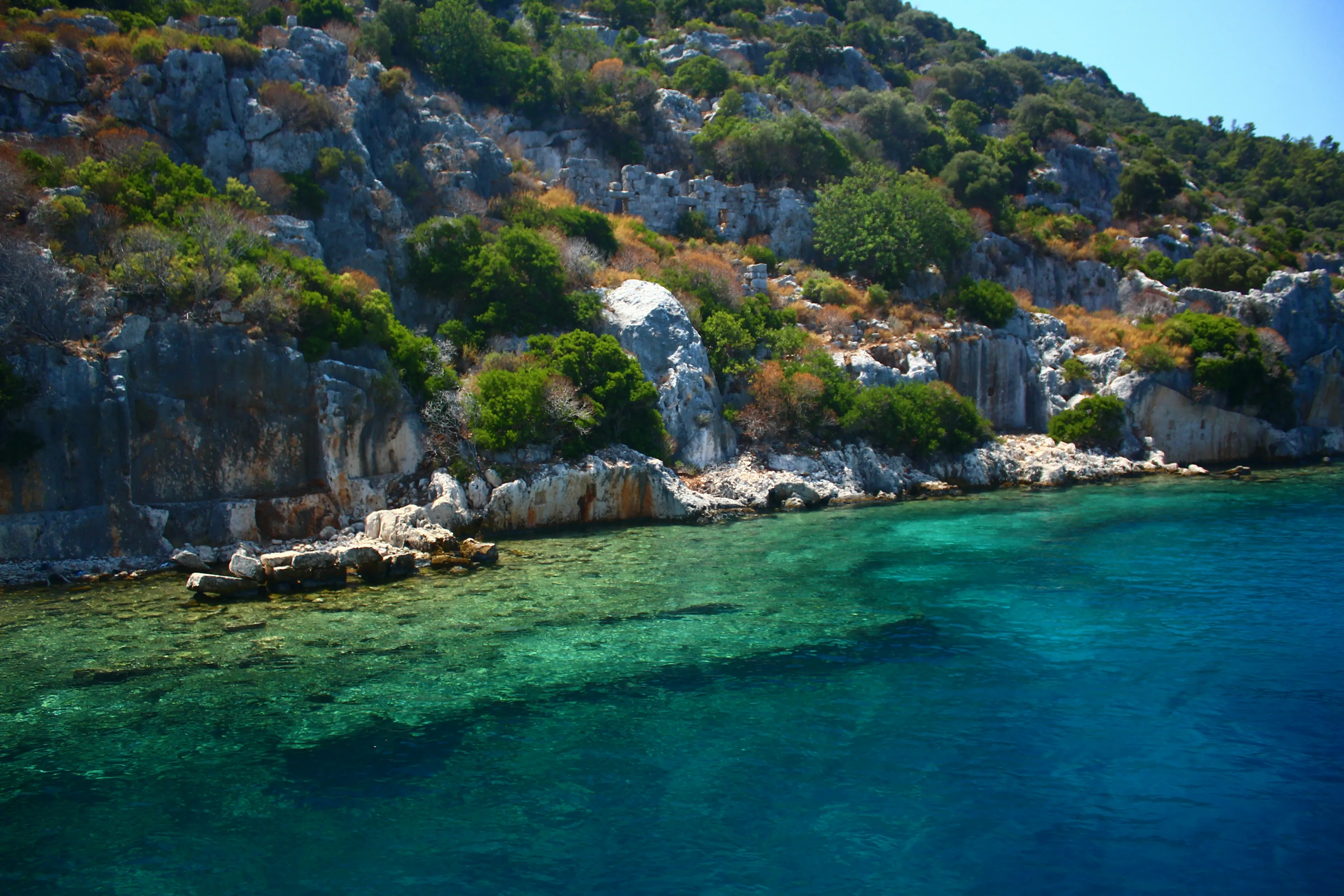
Most people come to Turkey’s southwest coast for the ruins. The Lycian tombs carved into sea cliffs, the sunken cities visible through ten metres of water, the amphitheatres where you can sit in the same seats as audiences two thousand years ago. All of that is here, and it is extraordinary - we have written about it elsewhere. But it is not the whole story.
The Turquoise Coast - roughly the stretch from Bodrum in the northwest to Antalya in the east, encompassing the provinces of Mugla and Antalya - sits at the intersection of three things that, taken together, make it one of the most compelling wellness destinations accessible by yacht. First: a landscape of pine-forested mountains dropping directly into warm, clean sea. Second: a culinary tradition that is arguably the original Mediterranean diet, built on olive oil, wild herbs, yoghurt and slow-cooked vegetables. Third: a bathing culture that predates modern wellness by two millennia, anchored in thermal springs and hammams that the Romans, Byzantines and Ottomans each inherited and refined.
This is not a coast where wellness has been imported. It is a coast where wellness has been practised, in one form or another, since before anyone thought to call it that.
The Forest and the Sea
The first thing you notice, sailing this coast, is the pine. Turkish red pine - Pinus brutia - covers the mountains that line the shore, descending in places to the waterline itself. The forest is dense, fragrant and, from a yacht anchored in a sheltered bay, close enough to smell. On still mornings, the scent drifts across the water: warm resin, baked earth, something faintly citric.
This is not merely pleasant. The science of forest bathing - shinrin-yoku, as the Japanese researchers who formalised its study call it - has demonstrated that the volatile organic compounds released by coniferous trees, known as phytoncides, produce measurable effects on human physiology. Research published in the International Journal of Immunopathology and Pharmacology found that exposure to phytoncides, particularly alpha-pinene and limonene, increased the activity of natural killer cells - a type of white blood cell that fights infections and tumours - while simultaneously reducing cortisol and adrenaline levels. Later research has echoed these findings, reporting increases in NK cell activation following phytoncide exposure. The effects persisted for up to thirty days after a forest visit.
On the Turquoise Coast, you do not need to trek into the forest to benefit. The mountains are so steep, the forests so close to the sea, that anchoring in a pine-backed bay - Gocek, the Twelve Islands, the coves between Kas and Kekova - effectively places you within the phytoncide zone. You are forest bathing and sea bathing simultaneously, which is a combination that most dedicated wellness retreats cannot offer.
The air quality deserves its own mention. The coast between Fethiye and Antalya has almost no heavy industry, minimal agricultural runoff, and prevailing winds that blow from the Taurus Mountains to the sea. The result is air that is measurably clean - rich in the negative ions generated by both pine forest and breaking surf, low in the particulate matter that characterises even wealthy European cities. If you have spent months breathing office air or urban air, the first deep breath in a bay off the Lycian coast feels less like fresh air and more like a substance you had forgotten existed.
Bathing as Medicine
Turkey has more thermal springs than any country in Europe. The southwest coast alone contains several that have been in continuous use for over two thousand years, and the most accessible by yacht are genuinely worth the detour.
The Sultaniye thermal springs, on the southeastern shore of Lake Koycegiz near Dalyan, have archaeological evidence of therapeutic use dating to the ancient Kaunos civilisation around 100 BC. The Romans later built a sanatorium here, the remains of which lie submerged beneath the lake. Today, the springs emerge at 39 to 40 degrees Celsius, rich in calcium, sulphur, iron and - unusually - radon, a naturally occurring radioactive gas that in controlled exposure has documented benefits for rheumatic and musculoskeletal conditions. The associated mud baths, fed by mineral-rich silt, have been a regional tradition for centuries. You reach Sultaniye by boat from Dalyan, passing the dramatic Lycian rock tombs of Kaunos on the way - which gives the excursion a quality that medical appointments on land rarely achieve.
Closer to the yachting routes, Kara Ada - Black Island - sits just six kilometres off the coast of Bodrum. The island’s volcanic geology produces thermal water that seeps from a cave at a constant 32 degrees, rich in sulphur and accessible only by boat. Yachts anchor in the small bay and guests swim into the cave mouth to soak in the mineral-rich water. The mud inside the cave, known locally as beauty mud, is applied to the skin and allowed to dry before rinsing in the sea. The legend that Cleopatra bathed here is almost certainly apocryphal but speaks to the longevity of the island’s therapeutic reputation.
Then there is the hammam itself - not the tourist experience of the large cities but the working neighbourhood hammam that still exists in towns like Kalkan, Kas and Fethiye. The hammam ritual dates to the Ottoman period and beyond, combining dry heat, steam, exfoliation with a kese glove, and massage on the heated marble platform called the gobek tasi. The physiological effects are not trivial: the combination of sustained heat and vigorous exfoliation increases circulation, opens airways, promotes lymphatic drainage and leaves the skin genuinely, measurably different. The social aspect matters too. The hammam was historically a communal space - a place for conversation, restoration and transition. Entering one in a Turquoise Coast town, particularly in the late afternoon when the light through the domed roof is golden, is an experience that operates on several registers at once: physical, cultural and quietly meditative.
Eating the Original Mediterranean Diet
The Mediterranean diet, as formally defined by the nutritional research of the 1950s onwards, was based primarily on observations of Cretan and southern Italian populations. But Turkey’s Aegean coast has an equally strong claim to the tradition, and in some respects a deeper one. Olive cultivation in Anatolia dates to at least 4000 BC - older than the Greek tradition by a considerable margin. Today, Turkey is home to more than 180 million olive trees, concentrated along the Aegean and Mediterranean coasts, producing oil with exceptionally high polyphenol levels.
The coastal cuisine of the Turquoise Coast is built on this foundation. The category of dishes known as zeytinyaglilar - literally, olive oil dishes - represents an entire philosophy of cooking: seasonal vegetables slow-cooked in generous olive oil with onion, garlic and fresh herbs, then served at room temperature. Artichokes, green beans, courgettes, aubergines, wild greens - each prepared simply, each allowing the quality of the oil and the freshness of the produce to do the work. Eaten at a harbour-side restaurant in Kas or served by a yacht chef who visited the morning market in Gocek, these dishes are anti-inflammatory eating in its most natural and enjoyable form.
The meze tradition extends this further. A typical Turkish coastal meal begins with five or six small plates - haydari (thick yoghurt with herbs), ezme (finely chopped tomato and pepper with pomegranate molasses), hummus, grilled octopus, stuffed vine leaves - shared slowly around a table. This slow, communal style of eating tends to leave people satisfied with less, not through restriction but through the natural deceleration that sharing imposes. You eat less because you eat longer. The food lasts because it is designed to last.
The wild herbs deserve a particular mention. The markets of the Turquoise Coast sell dozens of edible wild greens - radika, sevketi bostan, arapsaci - that are blanched or sauteed with olive oil and lemon and served as side dishes or stirred into borek. The herbalist tradition here is not a boutique affectation. It is the residue of a culture where food and medicine were not yet separate categories, where a plant was simultaneously an ingredient and a remedy and nobody saw a contradiction in that.
Where to Charter and When
The Turquoise Coast is a summer destination, but the optimal months for a wellness-focused charter depend on what you are prioritising.
May and June offer warm days - typically 25 to 30 degrees - without the peak heat and the associated crowds. The sea temperature by late May is comfortable for swimming at around 22 degrees, cool enough for the cold-water benefits but warm enough for extended time in the water. The pine forests are at their most fragrant after spring rains, and the markets are overflowing with early-season produce: cherries, strawberries, artichokes, the first figs.
September and October are the shoulder season that many experienced charterers prefer. The air temperature softens to 25 to 28 degrees, the sea retains summer warmth at 24 to 26 degrees, and the coastal towns empty enough that a hammam visit or a harbour-market morning feels unhurried. October in particular offers a quality of light - lower, warmer, more golden - that changes the entire character of the coast. The ruins look different. The mountains look different. Even the water, which gives the coast its name, shifts from the hard turquoise of midsummer to something softer and more complex.
July and August are the peak months: hot, bright, busy. The diving and swimming are at their best, the days are longest, and the coast operates at full capacity. For wellness-focused travellers, these months work best with a careful itinerary that moves east of Fethiye, where the coastline becomes less developed and the anchorages more remote. The stretch between Kas and Kekova - with its sunken city, its sheltered bays, its absence of road access - is almost as quiet in August as it is in May, because the geography keeps the land-based crowds away.
A Coast That Has Not Forgotten
There is a quality to the Turquoise Coast that distinguishes it from other Mediterranean wellness destinations. The French Riviera has spas, but they are imported luxuries. The Greek islands have clean air and good food, but they do not have the thermal springs or the bathing culture. Croatia has the coastline but not the depth of culinary tradition.
Turkey’s southwest coast has all of these things, and it has something else: continuity. The thermal springs at Sultaniye have been used for healing for over two thousand years. The olive groves were planted before the classical Greeks arrived. The hammam tradition has been refined across three empires. The zeytinyaglilar your chef prepares on a Tuesday evening in a bay off Gocek is not a wellness innovation. It is a way of eating that has been sustaining people on this coast since before the Lycians carved their tombs into the cliffs above.
When you anchor in a pine-backed bay on the Turquoise Coast - the forest above, the warm sea below, the air scented with resin and thyme - you are not visiting a wellness destination. You are visiting a place where the landscape, the food, the water and the bathing culture have been quietly, consistently, demonstrably good for human beings for a very long time. The science merely confirms what the coast has known all along.
Halcyon Voyage designs wellness charters along Turkey’s Turquoise Coast from April to October, incorporating thermal springs, hammam experiences and anti-inflammatory cuisine tailored to your wellness goals. Read our dispatch from the Lycian Shore for a first-person account of the journey.