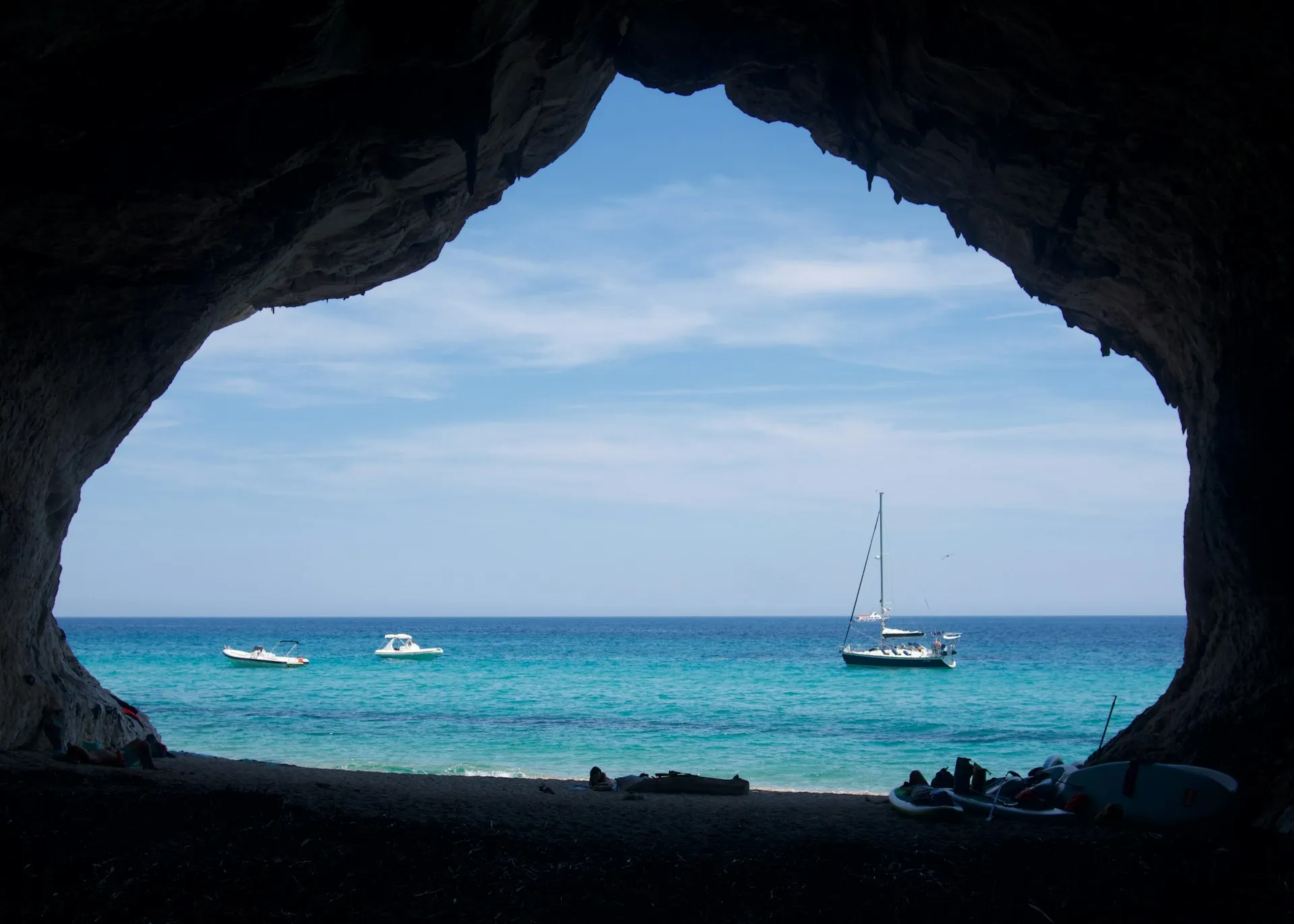
A wellness charter in Sardinia looks best once it turns its back on Porto Cervo. The short version is this: begin in the north-east because that is where the yachts and the airport are, spend a day or two among the protected islands of La Maddalena, and then go south down the east coast to the Gulf of Orosei, where limestone cliffs fall straight into the sea and several of the best coves have no road. Behind that coast are the mountain villages that gave the world the phrase “blue zone”. Go in June or early September.
The Costa Smeralda itself is a resort coast on a lovely piece of granite shoreline. There is nothing wrong with it. It is simply the busiest and most social water on the island, and almost everything that makes Sardinia restorative lies somewhere else.
La Maddalena: a national park with rules
The archipelago of La Maddalena sits in the Strait of Bonifacio, a few miles off the north-east corner of Sardinia. Seven main islands and a scatter of islets make up a national park of about 18,000 hectares, most of it sea, with some 180 kilometres of coastline. The water over the pale granite sand is the colour people come to Sardinia for.
It is also tightly regulated, and a calmer place for it. What follows is the position at the time of writing; the rules have changed more than once in the past two years and your captain will confirm what applies on your dates.
A permit is required. Every yacht needs a park authorisation to navigate, moor and anchor. The fee depends on the length of the yacht and the number of days. The current Italian pilot guide notes a 40 per cent reduction for sailing yachts and a small discount for buying online. Your crew handles this.
The park is zoned. In the integral reserve zones (MA) navigation, access and stopping are prohibited altogether. In the general reserve zones (MB), which cover most of the anchorages a guest will see, a yacht with a permit may navigate, pick up the park’s mooring buoys, and anchor only on sand or mud, never on the Posidonia seagrass meadows.
Speeds are low. For the summers of 2026 and 2027, from 1 June to 30 September, a trial regulation limits vessels to 7 knots within 500 metres of the shore and 10 knots between 500 and 1,000 metres. For anyone swimming or paddleboarding near the yacht, that is welcome.
Some bays have no-anchoring corridors. The same regulation marks transit corridors where anchoring is not allowed in several popular bays, among them Cala Corsara and Cala Connari on Spargi, Cala Santa Maria, and Porto Madonna.
Overnight anchoring has been contested. In August 2024 the park introduced a ban on anchoring overnight. It was challenged in court and suspended by the regional administrative court in June 2025, and the regulation that took effect in June 2026 does not mention it. The pilot guide still prints a dawn-to-dusk rule for the summer months. Until this is settled, treat a night at anchor inside the park as something to be confirmed rather than assumed.
Budelli and the pink beach
The Spiaggia Rosa on Budelli is the archipelago’s most famous sight and the one you will not set foot on. The sand takes its colour from the shell fragments of a tiny organism that lives on the seagrass offshore. By the late twentieth century, moorings and souvenir-taking had damaged both the meadow and the beach, and the colour was fading. Since 1998 the beach has been under full protection: no landing, no swimming, and boats kept behind a line of buoys about 70 metres from the shore. The colour has returned. You look at it from the water, and that is enough.
On Caprera, the coves of Cala Coticcio and Cala Brigantina can be visited on foot only with an authorised guide. In 2026 Coticcio was limited to 60 visitors a day, with a 3 euro environmental contribution on top of the guide’s fee.
When it is quiet and when it is not
In June and September the archipelago is far calmer. In August it is not. That month the Sardinian regional government wrote to the environment ministry in Rome that more than 6,000 boats a day were using the park’s waters at the peak, and the park’s own president complained that people were treating it like a theme park. If your dates are fixed in August, see La Maddalena early in the morning and then leave.
The Gulf of Orosei
Halfway down the east coast the granite gives way to limestone, and the island changes character. Between Cala Gonone and Santa Maria Navarrese the Supramonte plateau ends in cliffs, broken by dry gorges that reach the sea as small white beaches. For much of its length there is no coast road, which is the whole point. A yacht has the gulf at first light and again in the evening, when the day boats from the two small ports at either end have gone home.
The best-known coves are now managed, and a visit needs a little planning.
| Cove | How you reach it | Rules at the time of writing |
|---|---|---|
| Cala Goloritzé | On foot from the Golgo plateau above Baunei | Natural monument since 1993. No mooring within 300 metres of the shore since 1989. 250 people at a time, booked in advance, 7 euros per adult |
| Cala Mariolu | By sea | Landings capped at 700 people, 1 May to 20 October 2026. Landing ticket of 2 euros for one cove, 3 euros for several |
| Cala Biriala | By sea | Landings capped at 300 people over the same dates, same ticket |
| Cala Luna | By sea from Cala Gonone, or on foot from Cala Fuili | Mooring buoys offshore. Heavy day-boat traffic in season |
Cala Goloritzé is the one that surprises yacht guests. It is the most photographed beach on the coast, a small white beach under a slender limestone pinnacle, and you cannot arrive at it by boat. The exclusion zone keeps vessels well off, and the municipality of Baunei describes the beach as reachable only by land, down a footpath through the Baccu Goloritzé valley from a place called Su Porteddu. Entry is booked through the municipality’s website or its app. From the yacht you see it from the water, or you make a morning of it: a car up to the plateau, the walk down, a swim, and the climb back before the heat.
Cala Luna is the easier one. It can be reached from the sea, subject to whatever landing rules are in force that season, or you can walk in. The coastal path from Cala Fuili is about 10.5 kilometres there and back with roughly 370 metres of ascent in total, and walkers allow around four hours for the round trip. It runs through juniper along the cliff edge to a viewpoint before dropping to the beach. Walk in early and return by water, and you have the trail in the cool and no return leg. Later in the day the beach is busy with excursion boats.
A practical caution. This coast is sheltered from the prevailing north-westerly but wide open to the east, and it has almost no harbours. It is a fair-weather cruising ground. Our month-by-month guide to Sardinia’s winds explains when the settled spells are most dependable.
The longevity villages
Inland from the Gulf of Orosei, in the mountains of Ogliastra and Barbagia, is the area that first carried the label “blue zone”. It is worth being precise about what was found there.
In 2004 a team of researchers including Michel Poulain and Giovanni Pes published a study of people born on the island between 1880 and 1900. They calculated what share of each municipality’s births went on to reach 100, and mapped the result. The high values clustered in the mountainous central-eastern part of Sardinia. The term comes from that map.
Two findings stand out. Life expectancy in the area was higher than in the rest of the island, particularly for men. And men made up an unusually large share of the centenarians: the ratio of women to men among centenarians was 1.35 in the longevity area against 2.43 in the rest of Sardinia. Later demographic work on Sardinian centenarians, which located the area in the province of Nuoro, describes the same pattern: male death rates after 80 that are only modestly higher than female ones, and a surprisingly large number of centenarian men.
What the researchers did not find is a recipe. The 2004 paper says plainly that the mechanism is unknown, and its own first suggestion was genetic: centuries of isolation and marriage within small communities. A later review by Pes and colleagues looked at the traditional diet and described the idea of a dietary cause as a hypothesis. That review is also a useful corrective to the popular picture. The mountain villages lived mainly by herding livestock. Their traditional diet was built on cereals and dairy, and they ate more animal-derived food than the rest of the island. The authors suggest the generation now in question may have benefited from a frugal early diet followed by a more varied one after the 1950s.
So we would not tell you that a week in Sardinia will lengthen your life, or that any one food explains the villages. What a visit offers is more modest and, we think, more interesting: mountain villages a long way in spirit from the coast, and a way of eating that is local by habit rather than by fashion.
Eating well in Sardinia
Sardinian cooking belongs to shepherds as much as to fishermen, which sets it apart from most Mediterranean islands. For a charter chef that means two larders.
From the interior come sheep’s and goat’s milk cheeses, above all pecorino, fresh ricotta, and pane carasau, the thin, crisp flatbread of the shepherds. There are broad beans and chickpeas, wild fennel and artichokes, and Cannonau, the island’s red wine. From the coast come grilled fish, sea urchins in season, and bottarga, the cured mullet roe grated over pasta.
None of this needs dressing up as a programme. If you have particular aims, such as less sugar or no alcohol, the chef builds from the same ingredients. Our dispatch from a Sardinian table tells the story of one such week, and our guide to what a private chef does on a forty-metre yacht explains how provisioning works.
Walking and swimming
Sardinia rewards guests who like to walk as much as those who like to swim. The paths to Cala Luna and Cala Goloritzé are the obvious ones, and the gorges and plateau of the Supramonte behind them offer far longer days for those who want them. April and May are the best walking months on land; in July and August it is often too hot to walk comfortably after mid-morning, so we plan anything on foot for the first hours of the day.
The sea warms slowly. At Porto Cervo it averages 17.5 degrees in May, 21 in June, 24 in July and 25 in August, and it is still 23.5 in September and 21 in October. For long swims without a wetsuit, July to September is the window, with June perfectly comfortable for most people. The park’s low speed limits make the water around an anchored yacht in La Maddalena a calm place to be.
For families, this combination works well. Short passages, shallow sandy bays for younger swimmers, a walk with a beach at the end of it, and food that children recognise. Our family wellness page describes how a week like that is shaped.
Where it is quiet and where it is not
The table below is our own reading of the island, not a count.
| Area | In June and September | In late July and August |
|---|---|---|
| Costa Smeralda (Porto Cervo, Cala di Volpe) | Lively but manageable | The busiest water on the island |
| La Maddalena archipelago | Calm, especially the outer islands | Very crowded by day |
| Gulf of Orosei | Quiet outside the middle of the day | Day boats at every cove; quiet early and late |
| South-east, around Villasimius | Quiet | Busy beaches, fewer large yachts |
| West coast | Very quiet | Quiet, but exposed to wind and swell |
The famous beaches now have caps and tickets, not only in the Gulf of Orosei but at La Pelosa in the north-west (1,500 people a day) and Tuerredda in the south (1,100). A yacht does not escape that pressure entirely, but it changes the terms. You can be at a cove at seven in the morning and gone by eleven.
A week, sketched
Board near Olbia and spend the first night close by, doing very little. Give a day to La Maddalena, anchored on sand, with an early swim and a slow lunch. Then turn south and allow three days in the Gulf of Orosei, moving a few miles at a time: one morning walking to Cala Luna, one on the path to Cala Goloritzé, one doing nothing at all. The forecast will have a say in all of it. The Sardinia destination page gives the wider picture, and a wellness voyage here can be as active or as still as you want it to be.
Park rules, visitor caps and ticket prices in Sardinia are revised most seasons, and the figures here were current at the time of writing. Your captain and broker will confirm what applies on your dates. If you would like to talk through a week on the quieter side of the island, tell us what you have in mind.