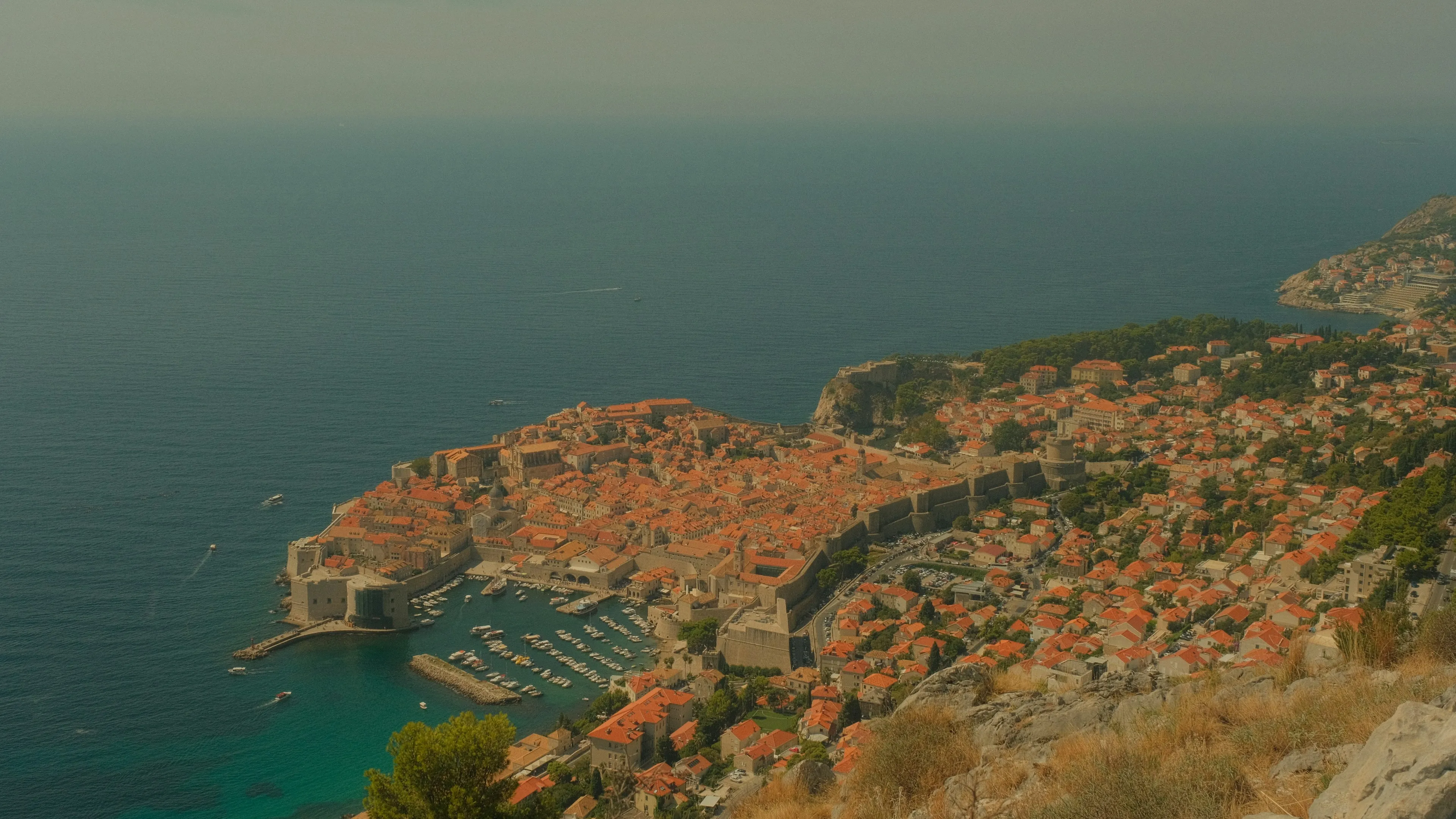
The Croatian Adriatic is calmest from June to early September, when a stable summer pattern brings light mornings, a moderate afternoon sea breeze and still nights. The coast is quietest in every month except July and August, which together account for more than half of the country’s tourist nights. Put the two together and the answer for a restorative charter is June or September: settled water, a sea warm enough to live in, and anchorages with room to breathe. May and early October are quieter again, at the cost of cooler water in May and a less dependable forecast in October.
The rest of this guide explains why, month by month, and how the answer shifts between the north, the centre and the south of the coast.
The three winds that shape the Adriatic
Almost everything about sea state on this coast comes down to three winds.
Bura (bora) blows from the north-east, off the mountains and out to sea. The Croatian Meteorological and Hydrological Service (DHMZ) describes it as known for gustiness, high speed and duration, strongest beneath the Velebit range in the north, and more frequent and stronger in the cold half of the year. Its record gust, 248 km/h (about 134 knots), was measured at the Maslenica Bridge near Zadar on 21 December 1998. In summer the bura is a much smaller affair. Charter operator Croatia Yachting describes it as a September to May wind that lasts a few days in summer and up to two weeks in winter. It arrives in squalls and usually leaves bright, dry, very clear air behind it.
Jugo (sirocco) blows from the south-east, warm and humid, and brings cloud, rain and a long swell. DHMZ notes that it is steadier than the bura, with a similar average speed, and that it is more intense and frequent in the middle and southern Adriatic than in the north. Unlike the bura it does not arrive suddenly. It builds over a day or more, which gives a captain time to move the yacht somewhere sheltered. It is mainly a wind of autumn, winter and spring.
Maestral is the summer wind: a sea breeze from the west and north-west that belongs to fine weather. It typically starts around 10 or 11 in the morning, peaks at about two or three in the afternoon and dies at sunset. One operator’s planning table gives prevailing winds in central Dalmatia of 12 to 14 knots from the west-southwest in June, July and August. In settled high pressure the pattern reverses at night, with a light breeze off the land.
For a guest, the maestral sets the rhythm of a summer day. The water is flattest from dawn until mid-morning, which is the time for swimming, paddleboarding and anything done on a mat on deck. The afternoon breeze cools the yacht and makes for easy passages. Evenings at anchor are usually still.
How the coast divides: north, centre and south
Croatia’s coast runs for several hundred kilometres from Istria to the Montenegrin border, and conditions are not the same along it.
| Kvarner and the north | Central Dalmatia | The south | |
|---|---|---|---|
| Main cruising ground | Krk, Cres, Lošinj, Rab | Split, Hvar, Brač, Vis, Kornati | Dubrovnik, Elaphiti, Mljet, Korčula |
| Wind to watch | Bura, strongest under Velebit | Both; afternoon maestral in the channels | Jugo, more frequent here |
| Sea temperature | Cools first in autumn | 23 to 24C in August at Split | Warmest in winter and late autumn |
| Crowding in high summer | Busy in July and August | Busiest charter waters in the country | Busy around Dubrovnik, quieter among the islands |
| Suits | Short hops in spring and early summer | First-time visitors, widest choice of anchorages | Late-season voyages, September into October |
The crowding row rests on port statistics. In 2025 Croatia’s nautical ports recorded close to 199,000 vessels in transit, and Split-Dalmatia and Šibenik-Knin counties, which cover central Dalmatia and the Kornati approaches, took just over half of them between them. Dubrovnik-Neretva county, by contrast, held about 4 per cent of the vessels on permanent sea moorings. The centre is where most of the charter fleet lives.
The sea temperature rows come from DHMZ’s long-term measurements. Dubrovnik’s sea averages 13.0C in January against 12.0C at Split, and 19.8C in October against 19.3C. The difference is modest but it runs in the south’s favour at both ends of the season. When we checked DHMZ’s live readings in mid November 2026, the sea was about 18C at Split and Dubrovnik and about 15C at Malinska and Opatija in the Kvarner.
January to March
This is the off season, and the figures say why. Mean wind speed at Split is at its highest between November and April, around 5 metres per second (roughly 10 knots) as a monthly average, with the bura and jugo doing most of the work. The sea at Split sits at 12C and reaches its annual low in February. Daytime highs climb from about 10C in January to 14C in March.
The coast is close to empty: the five months from November to March together hold under 5 per cent of Croatia’s annual tourist nights. Most charter yachts are laid up or in refit. We do not suggest these months for a voyage.
April and May
April is the start of the season in practice, and it is changeable. Days reach 17C at Split, the sea is still only about 14C, and spring is one of the jugo’s seasons, particularly in the south. The reward is a coast that has not yet filled.
May is the first month we would consider seriously for a wellness voyage. Daytime highs average close to 23C, sunshine is long, and the mean wind has dropped noticeably from its winter level. The honest drawback is the water: about 17C at Split, which is a brisk morning swim and not an afternoon afloat. For guests who want walking, quiet harbours, deck yoga and long lunches more than time in the sea, May is very good. Croatia recorded about 6.9 million tourist nights in May 2024, roughly a quarter of August’s figure.
June
June is the month we suggest most often. The summer pattern has usually settled in, the maestral gives warm, moderate afternoons, and mean wind speed at Split falls to its lowest of the year, a level it holds through July and August. Daytime highs average 27C and the sea reaches about 21C: fresh at the start of the month, comfortable by the end.
Crowds are building but have not peaked. June 2024 brought about 12.5 million tourist nights, under half of August’s total. Thunderstorms are part of an Adriatic summer and June has slightly more of them than July or August, about six days with thunder at Split on the long-term record. They tend to be short and to clear the air.
June days are also the longest of the year, which matters on a yacht. There is time for an early swim, an unhurried passage and an evening ashore without any of it feeling scheduled. It is a good month for a wellness retreat at sea.
July and August
These are the most settled weeks of the year and the least quiet. Daytime highs at Split average 30C, July averages only three or four days with measurable rain, and the sea climbs to 23C in July and about 24C in August. The DHMZ figures we use are 1971 to 2000 averages; NOAA satellite readings published by SeaTemperature.org put the August average at Split nearer 25C, with a recorded range of roughly 22 to 27C.
The trade is company. July and August 2024 accounted for 52.4 million of Croatia’s 93.7 million tourist nights, or 56 per cent of the year in nine weeks. On the water this shows up as full marinas, crowded town quays at Hvar and Korčula, and popular bays that fill by mid-afternoon.
A crewed yacht copes with this better than most ways of travelling. It can anchor away from the towns, arrive early, and choose the outer islands, Vis and Lastovo, or the quieter corners of Mljet and the Elaphiti. It is also the natural window for families: school holidays, the warmest water of the year and reliably swimmable days. Our guide to what to expect on a family charter covers the practical side. For stillness, though, these are not the weeks we would pick first.
September
September keeps most of what makes high summer pleasant and loses most of the crowd. The sea at Split averages just under 22C on the DHMZ record, only a degree or two below its August peak, because water gives up its heat far more slowly than air. Daytime highs ease to about 25C, which is kinder for sleeping, walking and eating outdoors than July’s 30C.
Tourist nights in September 2024 were about 11.2 million, some 40 per cent of August’s. Anchorages that were full a fortnight earlier have space again, and restaurants ashore can be booked on the day.
The qualification is that the weather is beginning to turn. Mean wind speed at Split is still low, but the first autumn fronts arrive during the month, rain days increase, and the same operator’s table shows the prevailing wind in central Dalmatia swinging round to the east-northeast, the bura’s quarter. In practice this usually means one or two unsettled days in a week, with fine clear weather behind them. The first half of the month is the safer half.
October
October is for guests who value solitude over certainty. The sea is still around 19C at Split and nearer 20C at Dubrovnik, daytime highs average 20C, and the coast has emptied: about 3.5 million tourist nights in October 2024, an eighth of August’s.
The bura and jugo are properly back, however, and the wettest part of the year is approaching. A week in October can be golden and still, or it can include two or three days in harbour. We suggest the south for an October voyage, where the water holds its warmth longest, and an itinerary with short passages and plenty of sheltered alternatives. The same thinking applies across the Mediterranean, as our guide to Greece in October explains.
November and December
November is the wettest month at Split, with about 100 to 110 mm of rain on the long-term averages, and December has the highest mean wind speed of the year. The sea cools from 16C to under 14C. The charter season is over.
Charter weeks and the Saturday changeover
Croatia’s large bareboat and skippered fleets run almost entirely on a Saturday to Saturday week. Croatia Yachting, one of the bigger operators, describes hundreds of boats checking in and out at the same time each Saturday, with waits at marinas, fuel docks and on the coast roads, and counts about 15 peak Saturdays in a season. Its own planning tables run from April to October, which is a fair outline of the working season.
Two things follow for a quieter voyage. The first is that the charter fleet moves as a wave: it leaves the bases around Split, Trogir, Šibenik and Dubrovnik at the weekend and returns at the end of the week, so the bays nearest those bases are busiest early in the week. The second is that a crewed yacht is often not tied to the Saturday pattern. Boarding on a different day, or in a different port from the fleet, avoids the busiest day of the Adriatic week altogether. Your broker will confirm what a particular yacht allows.
Which months suit a restorative voyage
- For calm water and warm sea with space: the first three weeks of September, then the second half of June.
- For solitude above all: May, or early October in the south.
- For families tied to school holidays: July and August, with an itinerary built around the outer islands and early arrivals.
- For reliable swimming: late June to late September, when the sea at Split is at or above about 21C.
If Croatia in high summer sounds too busy, the Greek islands offer a different trade between wind and crowds, set out in our Greek Islands month-by-month guide. If you have settled on the Adriatic, our Croatia destination page describes the coast itself, and the Voyage Designer will help you shape the week.
How we rate calm
The 1 to 5 calm rating in the month table is our editorial reading of typical wind and sea state for a guest at anchor and under way. It is not a forecast. We base it on DHMZ’s long-term mean wind speeds, rain days and thunder days for Split-Marjan, and on the seasonal behaviour of the bura, jugo and maestral described above. July scores highest because it combines the lightest average winds with the fewest rain days. August and June sit one step below because of brief thunderstorms, and September because the first autumn fronts arrive.
Air and sea temperatures in the table are DHMZ’s 1971 to 2000 averages for Split-Marjan (typical daytime high, and sea surface temperature), rounded to the nearest degree. Recent summers have generally run warmer than these normals. Crowd ratings follow the Croatian Bureau of Statistics’ monthly tourist nights for 2024, which cover all commercial accommodation in the country and are a guide to how busy the coast is, not a count of yachts.
Conditions vary from year to year and from one stretch of coast to the next; treat these as typical patterns, not promises. If you would like to talk through dates for your own voyage, tell us what you are looking for.