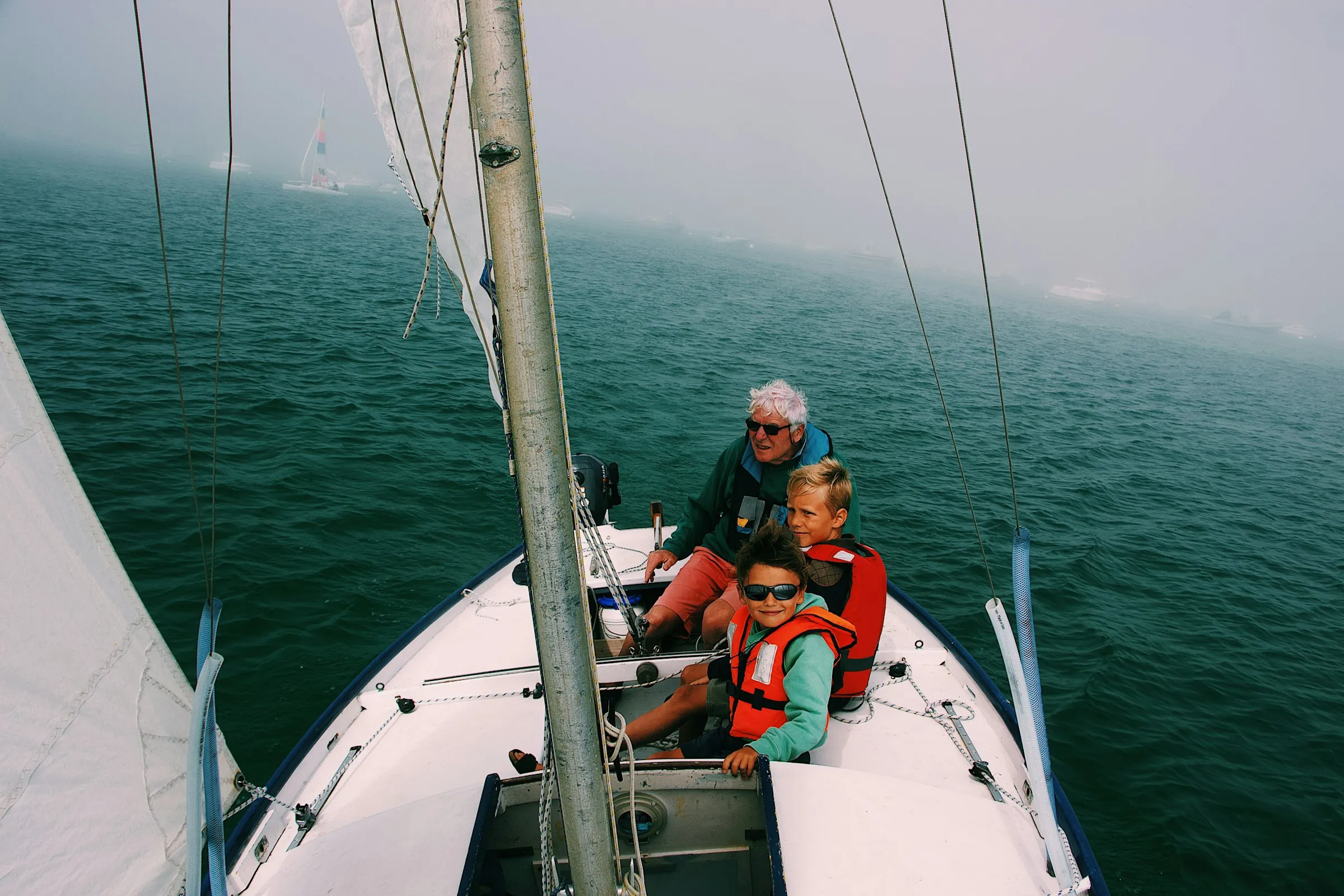
A crewed family yacht charter is best thought of as a private, fully staffed house that moves a short distance each day. The captain and crew handle the sailing, the cooking, the cleaning and the water toys. The children swim, paddle, snorkel and eat when they are hungry. Parents get something rare on a family holiday, which is time off from logistics. What the crew do not do, unless you arrange it, is look after your children: watching them near the water remains your job.
It suits almost any age, with different work involved at each. It is easiest once children can swim confidently, and it asks the most of parents when children are newly walking.
Cabins and sleeping arrangements
Charter yachts are laid out for adults travelling in couples, and families adapt the layout to suit themselves. The usual pattern is a master cabin, one or more further double cabins, and one or more twin cabins with two single beds. Some twins have an extra fold-down berth, often called a Pullman, which children tend to regard as the best bed on the boat. Each guest cabin normally has its own bathroom. The crew live in separate quarters with their own access.
A few things are worth checking on the deck plan before you choose a yacht.
- Where the twin cabins are in relation to yours. On many yachts the master cabin is on the main deck and the other cabins are a deck below. With young children, parents often prefer to give up the master and sleep in a double next to the twin. Worth Avenue Yachts, the brokerage behind Halcyon Voyage, puts it simply: connecting or nearby cabins help with young kids.
- Cots. Many yachts carry or can source a travel cot. Ask early, and ask which cabin has floor space for it.
- A nanny’s berth. If you bring a nanny, plan for the extra cabin. A nanny travelling as part of your party is normally counted in the guest number.
Catamarans deserve a mention for families. Their cabins are usually similar in size, set in the two hulls, with the saloon and cockpit on one level between them, so there are fewer stairs between where children sleep and where everyone lives. Our guide to how yacht size shapes the experience goes further into layouts.
Why the limit is 12 guests
Families are often surprised that a 40 metre yacht and a 60 metre yacht both take 12 guests. The number comes from international shipping law, not from the size of the boat.
The International Maritime Organization describes a passenger ship as one usually defined as carrying more than 12 passengers, and such ships on international voyages must meet the full requirements of the SOLAS convention, the main treaty on safety of life at sea. Those requirements are written with ferries and cruise ships in mind.
Yachts are built to lighter, purpose-written standards instead, and those standards are conditional on staying at or under the threshold. The most widely used is the Red Ensign Group Yacht Code, applied by the United Kingdom and its associated registries such as the Cayman Islands. Part A of the Code applies to yachts of 24 metres and over in commercial use for sport or pleasure that carry no cargo and no more than 12 passengers. The UK notice that implements it states that yachts carrying more than 12 passengers are not covered and fall under a separate part of the Code with heavier requirements. Other flag states have their own codes built around the same threshold.
In practice this means three things for a family.
- Children count. A six-year-old is one of the 12. The Code defines a person as someone over the age of one year, but how a baby is treated on a particular yacht depends on its flag, its certificates and its insurer, so ask your broker to confirm in writing.
- The yacht’s own number may be lower. Twelve is a ceiling. A yacht with four cabins may be certified and insured for eight guests.
- It cannot be stretched. A captain who declines a thirteenth guest for the night is following the law. Two families totalling more than 12 need two yachts or one of the few yachts certified to the higher standard.
Lifejackets and the safety briefing
Child-sized lifejackets are a requirement under the Code, not a courtesy. The July 2024 edition of Part A states that one suitably sized lifejacket shall be provided for each child and infant carried on board, with spares, and that the maximum number of children and infants the yacht is equipped for must be shown on its safety plan. This is the main reason your broker asks for the ages of your children when you book, and a good reason to send weights as well.
Fit matters more than presence. The Royal Yachting Association advises choosing a lifejacket by the child’s weight range, fitting it on the child, and then lifting it from the top: it should not rise more than 2.5 cm from the shoulders. Crotch or thigh straps must be fastened, because they stop the jacket riding up over the child’s head in the water. A jacket that is too big may not work properly and, in the worst case, a child could slip out of it. If your child is between sizes or very young, it is reasonable to bring your own.
Expect a safety briefing when you board, before the yacht leaves the dock. Ask the captain to include the children and pitch part of it at them. A sensible family briefing covers where the lifejackets are and how they go on, where to gather in an emergency, which doors and stairs are off limits, and the house rules for the trip. The rules we see most often are these:
- Lifejackets on in the tender and on deck under way for young children and non-swimmers.
- No child on the swim platform or the foredeck without an adult.
- No running on deck, and one hand for the boat when it is moving.
- No swimming until a crew member says the engines are off and the water is clear.
Parents of toddlers should also ask whether the yacht can fit safety netting along the guardrails, whether there are gates for the stairs, and whether the crew have hosted young children before. That last question is the one our brokerage advises every family to ask.
What the crew do, and what they do not
The division of labour on a crewed yacht is simple. The captain is responsible for navigation and safety. The chef plans and cooks every meal. The stewards look after the cabins and service. The deckhands run the tender and the water toys.
Good crews are often wonderful with children. A deckhand who spends an hour towing an inflatable or teaching a nine-year-old to paddleboard is a common sight. But crew are not childminders, they work long days, and the yacht still has to be run. If you want evenings off or reliable supervision in the water, bring a nanny or ask your broker whether one can be arranged locally, and budget a berth for them.
Food, allergies and the preference sheet
Before the charter your broker sends a preference sheet, a questionnaire about what each guest eats and drinks, what they dislike, and how they like their days to run. The chef plans menus and provisions the yacht from it, so it is the single most useful document a parent can fill in.
For children, be specific and unembarrassed. Write down the breakfast they will reliably eat, the plain pasta, the brand of milk, the time they need dinner and whether they eat separately from the adults. Most families settle into an early children’s supper followed by a later adult dinner, and chefs are used to cooking both.
Allergies and medical diets belong on the sheet in full: the allergen, how severe the reaction is, and what medication the child carries. Charter chefs routinely plan for allergies, religious diets and personal preferences, but a yacht at anchor is some distance from a pharmacy and a hospital, so for a serious allergy tell your broker at the enquiry stage, not on the sheet alone. That allows the captain to plan a route that stays within reasonable reach of medical care, and the chef to keep the allergen off the boat altogether if needed. Our piece on what a private chef does aboard explains how provisioning works.
What children do all day
More than most parents expect, and with very little organising. The yacht anchors in a bay and the bay becomes the playground.
Water toys are included in the charter fee, and paddleboards, inflatables and snorkelling gear are the family favourites. Larger yachts often add kayaks and towable rings. Ask for the toy list when you compare yachts, and ask what is suitable for your children’s ages. Some equipment, including personal watercraft, carries age and licence restrictions that vary by country.
A typical day has one short passage, usually over breakfast or lunch, and long stretches at anchor either side. In between there is a trip ashore in the tender: a beach, a village for ice cream, a short walk to a viewpoint. Evenings come early. Children who have swum for most of the day tend to sleep well.
Seasickness in children
This is the worry parents raise most, and the medical picture is fairly clear. According to the US Centers for Disease Control and Prevention, children under two do not usually experience motion sickness. Susceptibility rises after that, peaks between about seven and twelve years of age, and declines through adulthood. So the age group that gets the most from a yacht is also the one most likely to feel unwell on a lumpy passage.
The same guidance, and that of the NHS, favours behaviour over medicine as the first step. The measures both describe are practical on a yacht:
- Stay in the middle of the boat, where there is least movement, and avoid the bow.
- Look at the horizon or another fixed point.
- Stay in fresh air.
- Do not read, watch films or use a tablet under way.
- Distract children by talking, listening to music or singing.
- Avoid heavy meals shortly before a passage.
- Lying down with eyes closed can help.
The CDC advises that motion sickness medicines should be used with caution in children and that behavioural measures should be tried first. If you think your child may need something, speak to your doctor or pharmacist before you travel; the NHS notes that a pharmacist can recommend the best treatment for a child. We do not give dosing advice and nor should a crew.
The most effective measure of all is the itinerary. Tell your broker and captain if anyone in the family is prone to motion sickness, and they can plan short passages in sheltered water, made in the morning before the afternoon breeze.
Cruising grounds that suit children
The best family cruising grounds share three features: short distances between anchorages, shelter from open-sea swell, and warm water.
Croatia is the strongest choice for the northern summer holidays. The Dalmatian islands lie in long lines parallel to the coast, so much of the cruising is in protected channels and passages are often an hour or two. The sea at Hvar averages about 24°C in July and August and 21 to 22°C in June and September. Those are also the busiest weeks of the year, so a good captain will anchor away from the famous harbours. See our Croatia page and the Croatia month-by-month guide.
The Caribbean suits the winter and spring school holidays. Island groups such as the Virgin Islands offer short hops between anchorages with reliably warm water. It is less suited to the long summer break: the official Atlantic hurricane season runs from 1 June to 30 November, with most activity between mid-August and mid-October. Our Caribbean page and Caribbean month-by-month guide cover the seasons.
Wherever you go, ask for an itinerary built around the youngest child. One short move a day is plenty.
Which ages it suits
These are our editorial judgements, not rules.
Babies under one. Portable, usually untroubled by motion, and asleep much of the day. The work is shade, heat and a safe place to sleep. Ask about a cot and about air conditioning in the cabin.
One to four. The hardest age on a yacht. A newly mobile child near open water, stairs and low rails needs an adult within arm’s reach all day. It can be done, and is done often, but choose a yacht with a single-level layout, ask for netting, and consider a nanny.
Five to twelve. The easiest and most rewarding age. Children can follow rules, wear a lifejacket without protest and use most of the toys. This is also the age range most prone to seasickness, so plan the route accordingly.
Teenagers. They want activity and some independence: diving, wakeboarding, a paddleboard of their own, a cabin away from their parents. Ask about the yacht’s toys and whether any crew hold instructor qualifications.
If grandparents are coming too, our guide to multigenerational yacht charters covers three-generation trips. If this is your first charter of any kind, start with the first yacht charter guide, and our family wellness page describes how a week comes together.
Safety equipment, guest limits and rules for children vary by yacht, flag and country. Tell us your children’s ages and we will confirm the details for the yachts we suggest before you commit to anything.