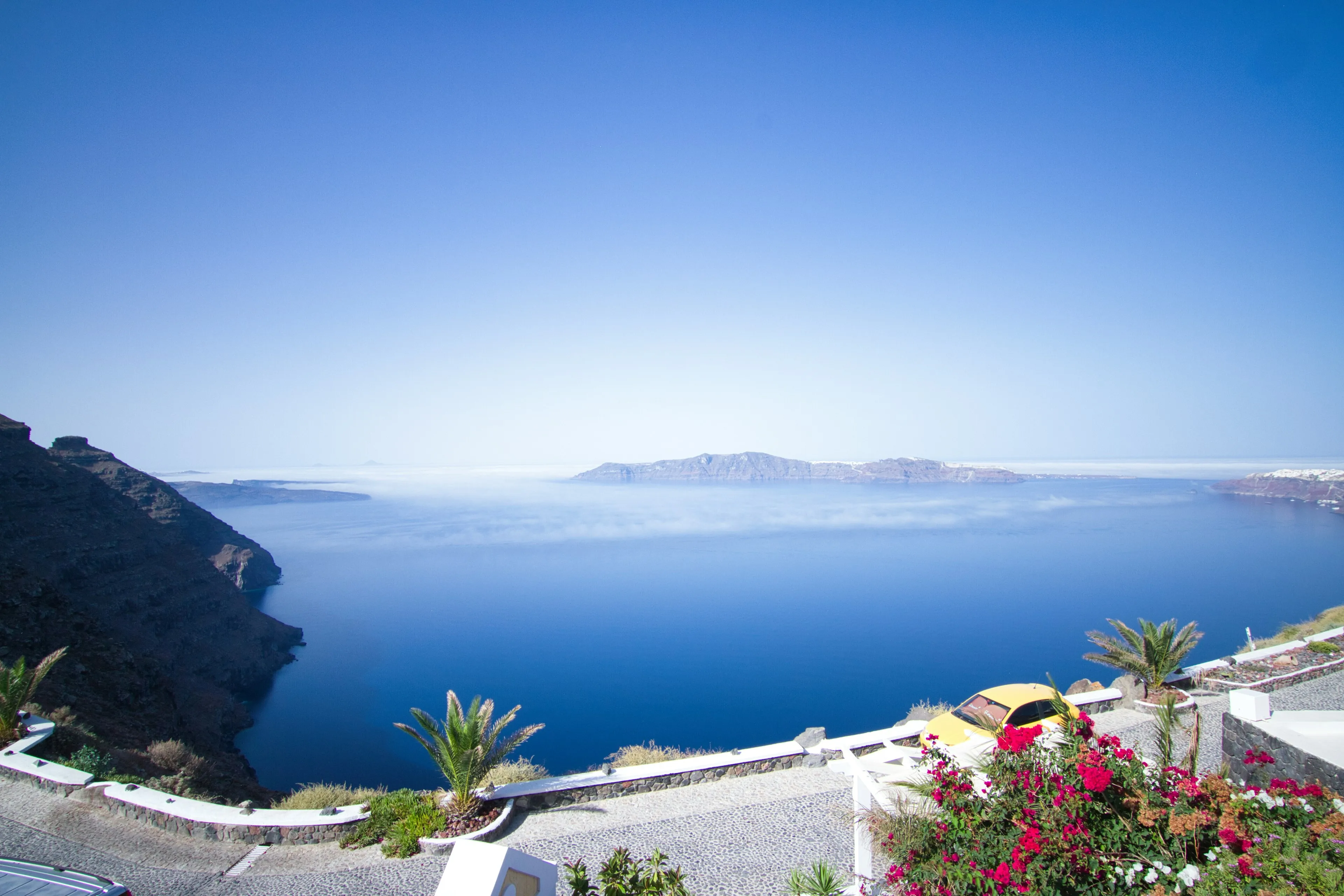
The Greek Islands are calmest for a yacht charter in May and early June, and again from the second half of September into early October. Between those windows, in July and August, the central Aegean belongs to the meltemi: a dry northerly that typically blows at force 4 to 5 and quite often at force 5 to 7, for days at a stretch. It does not reach everywhere. The Ionian islands on the west coast lie outside it, the Saronic and Argolic Gulfs feel a weaker version, and the Cyclades take it at full strength. So the honest answer to “when is Greece calm?” has two parts: which month, and which islands.
This guide covers the whole year, with the Cyclades as the reference area, and then explains how the other island groups differ. If you are weighing Greece for a wellness retreat at sea, it should help you choose both.
What the meltemi is
The meltemi is the modern name for the Etesian winds, the seasonal northerlies of the Aegean summer. It is a pressure-gradient wind. High pressure builds over the Balkans, a heat low sits over Turkey and the Anatolian plateau, and air runs south between the two across open water. A typical outbreak begins when an anticyclone moves over the Balkans behind a cold front.
Three things about it matter to a guest on a yacht.
It arrives under a clear sky. The meltemi is a fair-weather wind: dry air, sharp visibility, blue from horizon to horizon. A morning that looks perfect from the cabin window can be a force 6 morning.
It has a daily rhythm. A study in the journal Atmósfera, using observations around Naxos, describes Etesian days with wind peaking around the middle of the day at roughly 7.5 metres per second (about 15 knots) and falling below 5 metres per second (about 10 knots) around midnight. Sailing guides describe the same pattern from the deck: lightest at dawn, building through the morning or early afternoon, easing towards evening. A strong outbreak overrides the rhythm and blows through the night.
It comes in spells. Pilots’ notes describe blows lasting three to six days, sometimes up to ten, with quieter days between. A week in August may bring four windy days or none. Nobody can tell you which in January.
How strong it gets
The usual meltemi is force 4 to 5 on the Beaufort scale, which is 11 to 21 knots. Force 5 to 7 (17 to 33 knots) is described as not uncommon during the day, and in the Cyclades force 8 is possible. One sailing reference gives 20 to 25 knots as typical for the Cyclades in peak season.
Wind alone is only half of it. The sea state depends on fetch, the distance the wind travels over open water. Between the Cyclades and the Dodecanese the meltemi runs unobstructed for more than 100 nautical miles, and six hours of 30 knots there can raise waves of over three metres. Within the island chains the passages are shorter and the seas smaller, but the wind funnels and accelerates through the gaps: between Andros and Evia, between Paros and Naxos, north of Amorgos, south of Kea and Kythnos.
The lee of an island is not always the shelter it looks on the chart. On the southern sides of high islands such as Tinos, Andros, Serifos, Sifnos, Folegandros and Amorgos, the wind can fall down the slopes in hard gusts. A cap of cloud sitting over the downwind side of a mountain is the classic warning.
What it means on board
On passage, a meltemi day in the Cyclades means spray, motion and a yacht that is working. Heading south with the wind behind is brisk and often exhilarating. Heading north into it is slow and uncomfortable on any vessel, which is why good captains plan summer routes that run downwind, and make any unavoidable windward leg at first light before the wind builds.
At anchor, the effects are quieter but they accumulate. Wind in the rigging through the night. A swell that wraps round a headland and sets the yacht rolling at three in the morning. A tender ride ashore that soaks everyone. A foredeck too gusty for a yoga mat. None of this is dangerous on a well-run yacht with a professional crew, but it is the opposite of stillness, and it bears directly on how well you sleep aboard.
There are consolations. The meltemi is the reason a Cycladic August is bearable: daytime highs at Naxos average about 30°C, with dry air and a breeze, rather than the heavier heat of the mainland. It also keeps the sea a little cooler than you might expect in midsummer. And a crew who know the islands will always find a bay that is flat. The cost is flexibility: in a windy week, the weather chooses your itinerary.
Island groups compared
| Island group | Exposure to the meltemi | Summer wind in brief | What it means for a quiet voyage |
|---|---|---|---|
| Cyclades | Highest | North to north-west, typically 20 to 25 knots at the peak, force 8 possible | Best in May, early June, late September, early October |
| Dodecanese | High | West to north-west; force 7 occurs but less often than in the Cyclades | Shorter hops than the Cyclades; easy southbound, hard northbound |
| Northern Sporades | Moderate | North-east, force 4 to 7, less intense than the Cyclades | Small, green, compact; gusty in the lee of high ground |
| Saronic and Argolic Gulfs | Low to moderate | Mostly light; a weakened meltemi reaches the Saronic, gusts to force 6 | Short passages and nearby shelter; busy in summer |
| Ionian | Outside it | Maistro, north-west, force 2 to 5, afternoons only | Calm mornings and nights; the busiest sailing area in summer |
Cyclades
The strongest meltemi in Greece blows here, and the distances between islands are long enough for a sea to build. Calm days in July and August are the exception. This is also where the islands are at their most beautiful and most bare, which is why so many people want to come in exactly the wrong months. The German sailing magazine YACHT advises coming from May to early June or from late September to mid-October, and we agree.
Dodecanese
The meltemi bends here, arriving from the west or north-west along the Turkish coast. It is a regular feature of July and August and can reach force 7, though less often than in the Cyclades. The islands sit closer together, so passages are shorter. Routes are best planned one-way from north to south. In spring the winds are milder, around force 3 to 5. The same waters continue east into Turkey, which we cover in our guide to the Turquoise Coast.
Northern Sporades
Skiathos, Skopelos, Alonissos and their neighbours sit further north, where the meltemi is somewhat weaker and comes from the north-east at force 4 to 7. The group is compact, wooded and green all year, and a week can be spent here without a long passage. The caveat is gusts: the mainland mountains and the high islands themselves can throw sudden squalls into their lee.
Saronic and Argolic Gulfs
Aegina, Poros, Hydra, Spetses and the Peloponnese shore beyond are the nearest cruising ground to Athens. Most of the time the wind is light. The meltemi does reach the Saronic in July and August, usually weakened, with occasional gusts to force 6, and from Hydra onwards the coast gives some protection. Passages are short and there is always somewhere close to tuck in. The trade-off is company: this is one of the most crowded areas in high summer, especially at weekends.
Ionian
The Ionian, on the western side of the mainland, is not affected by the meltemi. Its summer wind is the maistro, a north-westerly of force 2 to 5 that typically fills in during the early afternoon and dies by evening, from June to September. Mornings are usually calm, nights often completely so. For still water in August, this is the most reliable part of Greece. It has two drawbacks: it is the most crowded sailing area in the country in summer, with Corfu and Lefkas the busiest, and spring and autumn bring more southerly winds and thunderstorms than the Aegean. The landscape is also different: green, soft and Venetian, not the white-and-ochre Cyclades.
The year in the central Aegean
November to March
This is the off season. Winter at Naxos is mild by northern standards, with daytime highs of 14 to 17°C, but it is rainy and windy, and the sea falls to about 16°C by February and March. Most charter yachts are hauled out after mid-November. Many island hotels and restaurants close.
April and May
The charter season opens around the middle of April. Spring is changeable and can be windy, with daytime highs near 20°C in April and a sea that is still about 16°C: wonderful for walking on islands that are green and in flower, bracing for swimming. May is the first truly settled month. Highs reach about 24°C, the sea warms to 18 or 19°C, and the islands are open but uncrowded. The first northerly spells can arrive from the middle of the month, usually short and moderate. For guests who care more about quiet than warm water, May is the best month of the year.
June
Early June is our favourite fortnight in the Cyclades: highs around 28°C, a sea of 21 to 22°C, long evenings and anchorages that still have room. As the month goes on the northerlies become more frequent and stronger, and by the last week the pattern of high summer is forming.
July and August
The meltemi’s peak, and the visitor peak too. Highs average 30°C and the sea reaches 24°C. In the Cyclades expect wind on most days and strong wind on some. Nationally, July alone accounted for 16.6 per cent of Greece’s international air arrivals in 2025, according to the tourism research body INSETE, and the famous harbours feel it. If these are your only possible months, Greece is still a fine choice, but choose the Ionian, the Saronic and Argolic, or a sheltered one-way route with a captain who knows the lee anchorages.
September
The sea is as warm as it gets, 23 to 24°C, and holds there all month. The first half of September can still bring full meltemi spells; the second half is noticeably gentler, and the crowds thin after the first week or two. Late September is the answer for anyone who wants warm water and calm together.
October
Highs fall to about 23°C, the sea stays near 21 or 22°C, and the meltemi is largely over. Early October is settled and very quiet. Later in the month southerly winds begin to bring the first autumn depressions, and some island businesses close. We have written about this month in detail in our guide to Greece in October.
Choosing for a restorative voyage
If stillness is the point of the voyage, these are the combinations we would suggest.
- May or early June, Cyclades or Dodecanese. Calm, quiet, flowering islands. Bring a thin wetsuit top if you like long swims.
- Late September to early October, Cyclades, Dodecanese or Saronic. The warmest water of the year, softening light, emptying anchorages.
- July or August, Ionian. Flat mornings, an afternoon breeze, calm nights. Expect company, and ask your captain for the quieter corners.
- July or August, Saronic and Argolic. Short passages, good shelter, and Hydra and the Peloponnese coast within reach. Avoid weekends in the popular harbours.
- July or August, Cyclades. Only if you enjoy wind and accept that the route will follow the forecast.
Yacht choice matters as well. A larger or heavier yacht is steadier in a seaway, and a shallow-draught one reaches tighter coves; our guide to how yacht size shapes the experience covers the trade-off. If the Adriatic is also on your list, it has its own wind pattern, set out in our Croatia month-by-month guide.
Our Greek Islands page describes the character of the islands themselves, and the Voyage Designer will let you sketch a voyage around the month you have in mind.
How we rate calm
The 1 to 5 calm rating in the month table is our editorial reading of how settled the water typically is for a guest at anchor and under way in the Cyclades. It is based on the wind patterns described in the sources below. It is not a forecast, and any single week can differ from the typical one. The crowd rating is a similar judgement, drawn from national arrival patterns and the charter calendar. Air temperatures are average daytime highs for Naxos, in the central Cyclades, for 2004 to 2020, and sea temperatures are monthly averages for the water around Naxos, both rounded to the nearest degree. The Ionian would score higher for calm in July and August than the table shows, and the Saronic somewhat higher.
Wind and sea conditions vary from year to year, and a meltemi can arrive early, late or hardly at all. Your captain will plan each day around the forecast. If you would like help matching a month to an island group, tell us what you have in mind.