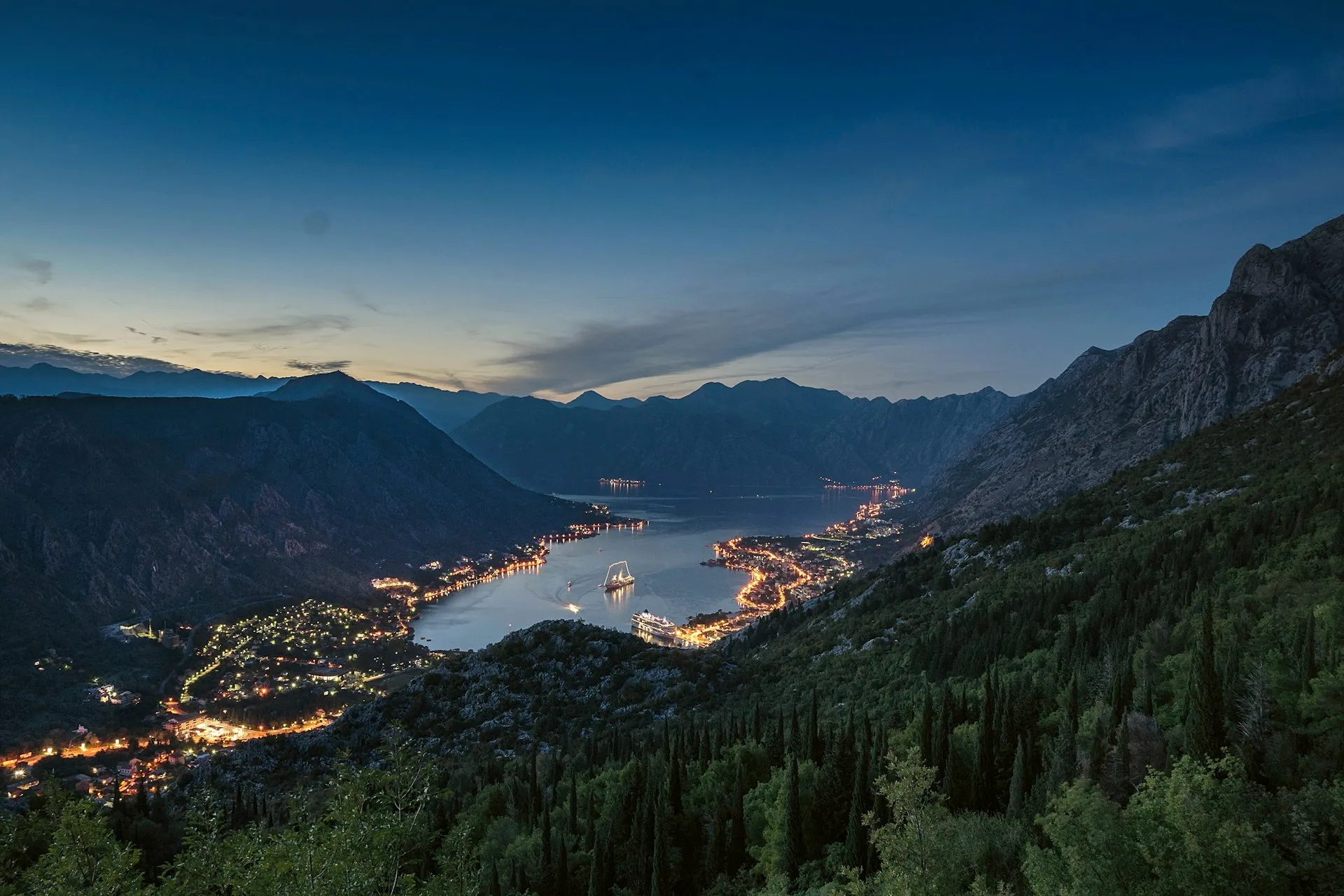
Montenegro’s water is at its most settled from June to early September, and the Bay of Kotor is flatter than the open coast in almost any weather. The coast is quietest outside July and August, with one exception: cruise ships keep Kotor’s old town busy from May right through October. For a calm, restorative charter the answer is June or the first half of September, with late May close behind for guests who do not mind a cool sea. From October to March the bay is one of the wettest places in Europe, and we would not plan a voyage then.
Why the Bay of Kotor is so sheltered
The Bay of Kotor, known locally as Boka, is a chain of basins about 28 km long that winds inland between the Orjen massif to the north-west and Lovćen to the east. The inner basins of Risan and Kotor connect to the rest of the bay through the Verige strait, which is only about 340 metres wide at its narrowest. Open-sea swell does not survive that journey. Pilot notes describe the gulf as a large, almost enclosed bay of three basins.
On a settled summer day the pattern is simple. Notes written for the 44Cup regattas held off Tivat describe an onshore south-westerly thermal breeze that starts at about 11 in the morning and reaches 10 to 12 knots, steady and over flat water. It fades towards evening. Mornings and nights are usually still.
That is the shape of a wellness day here: glassy water at dawn for swimming and paddleboarding, a breeze to cool the yacht after lunch, and a quiet anchorage at night.
The open coast from Budva to Ulcinj
Outside the entrance at Herceg Novi, the coast runs south-east past the Luštica peninsula to Budva, Sveti Stefan, Bar and Ulcinj. This is ordinary Adriatic water, open to the south and west. Pilot notes give winds here as usually south-easterly or north-westerly, with the afternoon sea breeze strengthening a north-westerly to about force 3 to 5 (roughly 7 to 21 knots) before it drops in the evening, sometimes leaving a chop behind. Anchorages such as the bay at Sutomore are open to the south and south-west.
| Bay of Kotor | Open coast | |
|---|---|---|
| Summer wind | South-west thermal, 10 to 12 knots, from late morning | North-westerly sea breeze, force 3 to 5 in the afternoon |
| Sea state | Flat; no swell reaches the inner basins | Afternoon chop; swell with southerly winds |
| Wind to watch | Bora gusts off the mountains, strongest at Risan | Jugo swell; bora noted as violent at Bar |
| Rainfall | About 1,790 mm a year at Herceg Novi | About 1,360 mm a year at Bar |
| Crowding | Cruise ships at Kotor, May to October | Beach resorts, July and August |
| Suits | Still mornings, short hops, shoulder months | Beaches and longer passages in high summer |
The rainfall row uses 1991 to 2020 climate normals for the two stations.
Bora and jugo on this coast
The bora (bura) is a cold, dry wind from the north-east. Imray’s Adriatic Pilot describes the mechanism: cold air held behind the coastal mountains falls down the slopes towards the sea, arriving suddenly and reaching gale force within three or four hours. It is strongest close to the shore, at the mouths of valleys, and where mountains of more than 600 metres stand within about 3 km of the coast. That description fits the inner bay closely. The same source puts the bora at about 20 per cent of the time in winter and 5 per cent in summer across the Adriatic, with gales typically lasting around 12 hours.
In the bay, the mountains block the waves but not the wind. The 44Cup notes describe the Verige strait as an acceleration zone that brings gusts of 20 to 30 knots onto the water off Tivat, and say a build-up of cumulus over the mountains is the usual warning. Pilot notes add that the strongest winds in the gulf occur in the Bay of Risan. On the open coast, the same notes single out Bar for particularly violent bora in winter.
For a guest, a summer bora in the bay means a gusty, bright, very clear day on flat water, usually spent alongside or tucked under a windward shore.
The jugo (sirocco) is the warm, humid south-easterly that comes with fronts and rain, mostly from autumn to spring. On the open coast the jugo sends a swell into every south-facing anchorage. Inside, according to the 44Cup notes, it more often leaves the bay overcast and close to a mill pond. A captain’s usual answer to a jugo forecast is to go in through the strait and stay there.
How wet autumn and winter are
The southerly air that brings the jugo is forced up the wall of Orjen, and it drops its rain as it rises. The weather station at Crkvice, at 937 metres in the Krivošije highlands on the slopes of Orjen, averaged 4,593 mm of precipitation a year over 1961 to 1990. The peer-reviewed study that reports the figure describes it as the highest average annual precipitation found in Europe, with 1,703 mm of it falling in winter.
Sea level is drier, but still very wet by Mediterranean standards. Herceg Novi, at the mouth of the bay, averages 1,794 mm a year: 246 mm in December and 231 mm in November, against 39 mm in July. We did not find an official long-term normal for Kotor town itself, so we use Herceg Novi and Crkvice to bracket it.
July averages between three and four days with measurable rain; November and December average 11 to 12 each.
January to March
Daytime highs at Herceg Novi climb from 13C in January to 16C in March. The sea off Tivat sits at about 14C and reaches its low in February. Around 170 to 200 mm of rain falls in each of these months, and the bora is at its most frequent. Most yachts are laid up or in refit, and the cruise schedule for Kotor shows no calls at all until the last days of March. This is the off season.
April and May
April is changeable: 19C by day, a sea of 15 to 16C, about 160 mm of rain and regular spells of bora and jugo. The hills are at their greenest and the bay is nearly empty, but it is a month for walking and harbour towns more than for the water.
May is the first month we would suggest. Daytime highs average close to 24C, rainfall drops to about 105 mm, and the afternoon breeze pattern begins to establish itself. The drawback is the sea, at about 19C, which makes for a brisk swim.
June
June is our first choice. Days average 28C, the sea reaches about 23C, and rain falls on only about five days. The thermal breeze is dependable and the long evenings are warm enough to eat on deck. The beach resorts of the open coast have not yet filled, and away from Kotor the bay is unhurried. It is a fine month for an active voyage: swimming and paddleboarding before breakfast, and the old mule tracks above the bay before the heat builds.
July and August
These are the most settled weeks of the year, and the hottest. Daytime highs average 31 to 32C at Herceg Novi, where about 21 days in each month reach 30C or more. The sea off Tivat averages 25 to 26C. July is the driest month of the year.
They are also the busiest. Kotor’s cruise schedule peaks, with as many as five ships listed on a single day in 2026, and the beaches from Budva to Sveti Stefan are at capacity. A crewed yacht copes better than most ways of travelling: it can visit Kotor and Perast early or late in the day, spend the hot hours swimming off the Luštica shore, and anchor away from the towns at night. For stillness, though, we would look either side of these weeks.
September
September keeps the warm water and loses most of the beach crowd. The sea averages about 24C, days ease to 27C, and nights are cooler for sleeping. The first autumn fronts arrive during the month, and rainfall rises to about 140 mm, spread over about seven days. The first half of the month is the safer half.
One caution: the cruise ships do not leave with the school holidays, so Kotor’s old town stays busy even as the anchorages empty.
October
October is for solitude over certainty. The sea is still about 21C and days reach 22 or 23C, but rainfall climbs to about 170 mm and the bora and jugo are properly back. The bay’s shelter is at its most useful now: a week that would be uncomfortable on the open coast can still be pleasant inside.
November and December
These are the wettest months, with 230 to 250 mm each at Herceg Novi and rain on 11 or 12 days. The sea cools from 19C to 16C. The charter season is over.
Cruise ships at Kotor
Montenegro’s statistical office recorded 496 cruise voyages by foreign vessels in 2025, carrying 630,236 passengers. Kotor is the main port of call, a town Reuters put at about 23,000 inhabitants. Reuters also reported one day in August 2024 when four ships landed about 5,000 visitors.
The official figures are annual, so for the monthly pattern we counted the calls listed in CruiseMapper’s 2026 schedule: about 25 in April, 50 in May, 60 in June, 75 in each of July and August, 70 in September, 65 in October and under 20 in November. These are scheduled calls, not passenger counts, and our tally is approximate.
On a yacht, ship days can be managed. Passengers are typically ashore from mid-morning to late afternoon; Kotor at eight in the morning, or after six in the evening, is a different town.
Marinas, fuel and tax
Montenegro’s working season runs roughly from May to October, with April possible. Three marinas matter to charter guests:
- Porto Montenegro, in Tivat, lists more than 500 berths for yachts of up to 250 metres and is about ten minutes from Tivat airport.
- Portonovi, at the entrance to the bay near Herceg Novi, lists 238 berths for yachts of up to 140 metres and has its own border crossing with clearance around the clock.
- Luštica Bay is a smaller marina on the seaward side of the Luštica peninsula, well placed for the open coast.
On tax, Montenegro sits outside the EU. The charter broker IYC, in a table updated in May 2026, lists VAT on charters cruising in Montenegrin waters as 0 per cent, “generally applicable”. On fuel, a trade report from March 2025 said tax-free fuel was once again available to foreign private and commercial yachts at Porto Montenegro, Portonovi and Marina Bar, on conditions that included a minimum stay of 72 hours and leaving Montenegrin waters after refuelling. That wording tells you the concession has not been constant. Treat both points as the position at the time of writing; your broker will confirm what applies to your yacht and dates. Our guide to what a charter costs explains how these extras fit together.
Combining Montenegro with Dubrovnik
The Croatian border lies just beyond the mouth of the bay, and Dubrovnik and the Elaphiti islands are the natural extension of a week here. Croatia is in the EU and Montenegro is not, so the yacht clears out of one country and into the other, which takes time out of the itinerary. And IYC notes that Croatian VAT, 13 per cent for qualifying charters, may apply to the time spent in Croatian waters, and that the yacht needs the appropriate Croatian charter licence. Raise it early.
The weather logic is the same on both sides of the border, and our Croatia month-by-month guide covers the neighbouring coast in detail.
Which months suit a restorative voyage
- For calm water and warm sea with space: June, then the first half of September.
- For solitude above all: late May, or early October inside the bay.
- For families tied to school holidays: July and August, with Kotor visited early and nights at anchor away from the towns.
- For reliable swimming: mid June to early October, when the sea off Tivat averages 21C or more.
Montenegro suits guests who want mountains with their sea: a wellness retreat on water that barely moves, with serious walking close at hand. Our Montenegro destination page describes the coast itself, and the Voyage Designer will help you shape the week.
How we rate calm
The 1 to 5 calm rating in the month table is our editorial reading of typical wind and sea state for a guest at anchor and under way. It is not a forecast. It is weighted towards the Bay of Kotor and rests on the rain-day normals for Herceg Novi and the seasonal behaviour of the bora, jugo and sea breeze described above. July and August score highest because they are the driest months with the most regular breeze pattern. June and September sit one step below because fronts and thunderstorms are more likely. The winter months score 2, not 1, because the bay stays free of swell even when it is wet and gusty; the open coast in winter would rate lower.
Air temperatures are 1991 to 2020 normals for Herceg Novi (mean daily maximum). Sea temperatures are for Tivat, from SeaTemperature.info’s ten-year averages of satellite and in-situ data; surface water in the inner basins may differ after heavy rain. Crowd ratings combine the Kotor cruise schedule with the general pattern of the beach season, and are a judgement, not a count.
Conditions vary from year to year and from one basin to the next; treat these as typical patterns, not promises. If you would like to talk through dates for your own voyage, tell us what you are looking for.