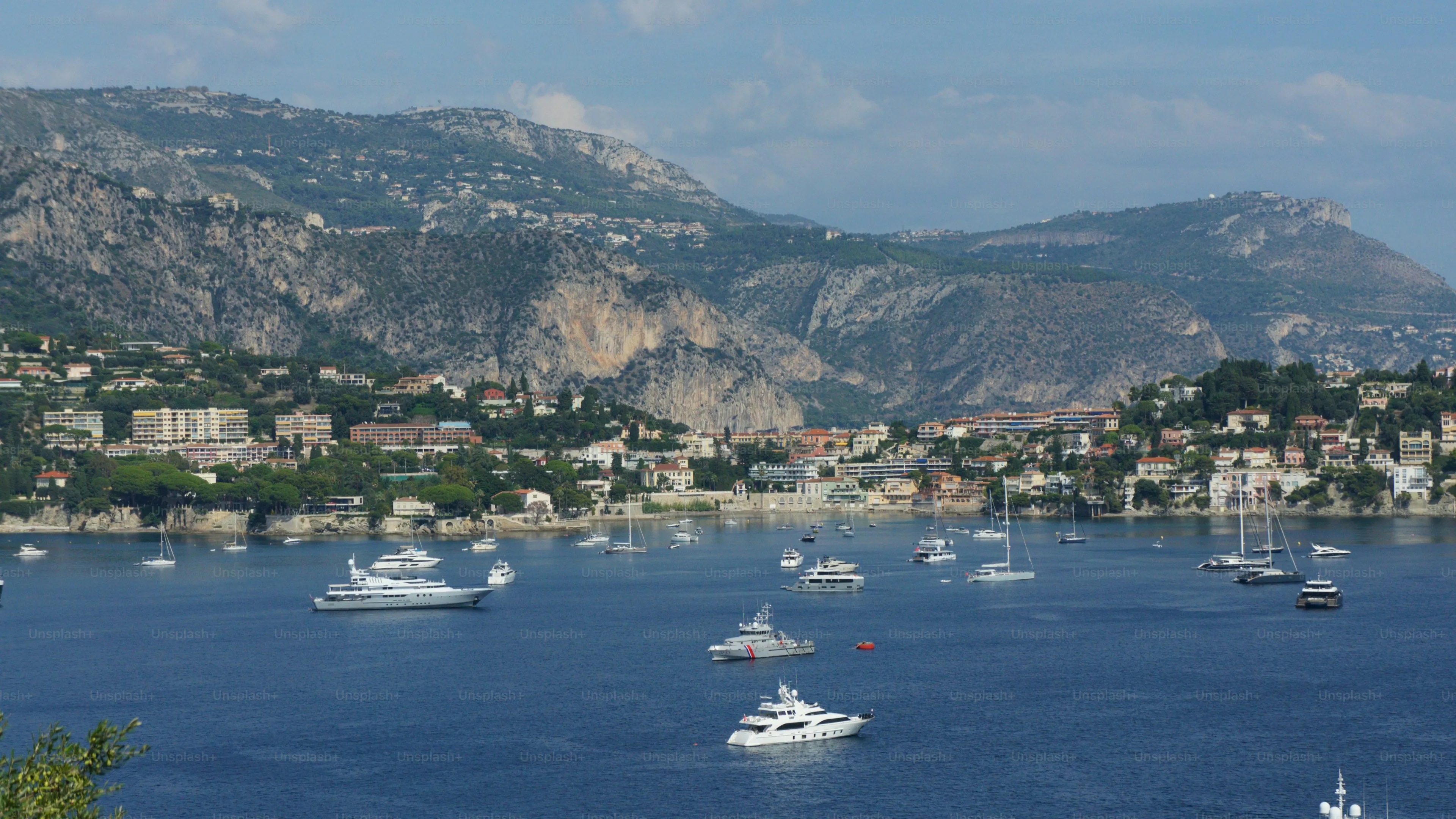
The French Riviera’s water is most settled from June to August. Those are the months when Nice records its lightest average winds, its fewest gusty days and very little rain. The coast is quietest outside July and August, when the visitor population peaks. Put the two together and the answer for a restorative charter is June or the first three weeks of September: light winds, a sea of 22 to 24C, and anchorages with space in them. Where you go matters almost as much as when. The eastern Riviera, from Cannes to Monaco, sees far less of the mistral than the Var coast around Hyères, Porquerolles and Saint-Tropez.
This guide covers conditions only. For what to do once you are there, see our French Riviera wellness guide.
The mistral and how far it reaches
The mistral is the wind that defines the western half of this coast. Météo-France describes it as a dry, turbulent regional wind that blows from the north down the Rhône valley, from the north-west around Marseille and from the west along the Var coast. It averages about 50 km/h (27 knots) with gusts of 80 to 100 km/h (43 to 54 knots), is usually stronger in winter and spring, and can last several days or sometimes more than a week. It is a dry wind that clears the sky, so the windiest days in the Var are often the brightest.
It does not reach the whole Riviera equally. Météo-France’s own explainer notes that people do not speak of the mistral at all in the Nice area. The long-term station records show the difference plainly. Hyères, at the western end of the cruising ground, averages 78 days a year with gusts of 58 km/h (31 knots) or more. Nice averages 44. In July the figures are about six days at Hyères and two at Nice.
Those counts include wind from every direction, so they measure exposure in general, not the mistral alone.
| Western Riviera (Var) | Eastern Riviera (Alpes-Maritimes and Monaco) | |
|---|---|---|
| Cruising ground | Hyères, Porquerolles, Port-Cros, Saint-Tropez | Cannes, Lérins, Antibes, Villefranche, Monaco |
| Mistral | Arrives as a strong west wind | Rarely felt as mistral |
| Days a year with gusts over 58 km/h | 78 at Hyères | 44 at Nice |
| Gusty days in July and August | About 6 and 4 at Hyères | About 2 in each month at Nice |
| Daytime high in August | 29.0C at Hyères | 27.9C at Nice |
| Character | National park islands, long beaches, more wind | Short hops, deep sheltered bays, more traffic |
For a guest, the practical point is that a week in the west needs a little more flexibility: if a mistral is forecast, a captain will usually wait a day in shelter or reverse the route.
Easterly winds, swell and the summer sea breeze
The Riviera’s other weather comes from the opposite direction. When a depression sits over the western Mediterranean, the wind turns east or south-east and brings humid air, cloud and rain. This is mainly an autumn pattern. Nice receives 128 mm of rain in October and 138 mm in November on the 1991 to 2020 averages, against 14 mm in July, and October has more thunderstorm days than any other month.
Much of this coast faces south and east, so easterly weather brings swell into anchorages that are comfortable in a mistral. We have not found a reliable published monthly frequency, so we describe it qualitatively: uncommon in high summer, a real consideration from late September.
Fine summer days follow a simpler rhythm. Mornings are usually calm. As the land heats, a sea breeze fills in from late morning or early afternoon and fades towards evening. Nice’s mean wind speed in June, July and August is 3.3 to 3.4 metres per second (about 6.5 knots) averaged across the whole day and night, the lowest of the year. The early hours are the still ones.
January to March
Winter on the Riviera is mild and bright, with daytime highs of 13 to 15C at Nice, but it is not charter weather. The sea is at its coldest, 14C or just under, and this is the windiest part of the year. Nice’s mean wind is highest in December and January, and March has the most gusty days at both Nice and Hyères, about five and eight respectively.
The coast is at its emptiest: hotel occupancy in the Alpes-Maritimes and Monaco was 41 per cent in January 2024, against 86 per cent in August.
April and May
April is changeable. Days reach 17C, the sea is about 15C, and Nice still averages nearly five gusty days in the month. It suits walking and empty harbours more than time in the water.
May is the first month we would consider seriously. Daytime highs average 21C, the mean wind has dropped, and gusty days fall to between three and four. The sea is the drawback, at just under 18C on average.
May also contains the Riviera’s two best-known events. The Festival de Cannes runs for about two weeks in the middle of the month; the 2027 edition is listed for 11 to 22 May. The Monaco Grand Prix traditionally followed in late May, though in 2026 it moved to the first weekend of June, so check the current calendar. During both, berths and anchorages around Cannes and Monaco are in heavy demand and yachts are booked well ahead. A quiet voyage in May should start somewhere else, or in a different week.
June
June is the month we suggest most often. Daytime highs average just under 25C, rain falls on fewer than four days, and gusty days at Nice drop to two or three. The sea climbs quickly, averaging about 22C across the month, cooler at the start and warmer at the end.
The coast is busy without being full. Hotel occupancy was 81 per cent in June 2024, but the school holiday crowd has not yet arrived. It is a natural month for a wellness retreat at sea.
July and August
These are the most settled weeks of the year. July is the driest month, with about 14 mm of rain at Nice and under 8 mm at Hyères, and the sunniest, with close to 350 hours. August has the fewest gusty days of any month at Nice, fewer than two. Daytime highs average 27 to 28C at Nice and 29C at Hyères. The sea averages about 25C in both months, with a range over the past decade of roughly 20 to 29C.
They are also the least quiet. The regional tourism board counts an average of 200,000 visitors present in the Alpes-Maritimes and Monaco on any day of the year, rising to a peak of 650,000 on the weekend of 15 August. The four months from June to September account for six in ten of the area’s 70 million annual tourist nights. On the water this means full marinas and crowded anchorages off the best-known beaches.
A crewed yacht handles this better than most ways of travelling, by moving early and anchoring away from the towns. For stillness, though, these are not the weeks we would pick first.
September
September keeps most of what makes high summer pleasant. The sea averages just under 24C, only a degree or two below its peak. Daytime highs ease to about 25C. Gusty days at Nice are still low, about three.
The weather is beginning to turn, however. Rainfall at Nice jumps to about 80 mm, mostly in short heavy bursts, and thunderstorm days rise to four. The first half of the month is the safer half.
September is not as quiet on land as it is elsewhere in the Mediterranean. Hotel occupancy in 2024 was 81 per cent, the same as June, because the conference and event season resumes. Two events matter to anyone on a yacht. The Monaco Yacht Show occupies Port Hercule for four days in late September (22 to 25 September in 2027). Les Voiles de Saint-Tropez, first held in 1999, brings about 250 classic and modern sailing yachts to the gulf for nine days from the last weekend of September into early October. Neither is restful. For calm, we suggest the first three weeks of the month. Those weeks also suit a corporate retreat, and our guide to planning a corporate retreat at sea covers the practical side.
October
October is for guests who value an empty coast over a dependable forecast. The sea is still about 21C and daytime highs average 21C. Hotel occupancy drops to 64 per cent.
It is also the start of the wet season. Nice averages seven or eight days of rain and four with thunder, and the month’s 128 mm often arrives in a few heavy falls driven by easterly weather. A week can be golden and still, or it can include two or three days in harbour.
November and December
November is the wettest month at Nice, with about 138 mm of rain, and December has the highest mean wind of the year. The sea cools from 18C to 16C. The charter season is over.
Anchoring rules for larger yachts
Posidonia is a slow-growing seagrass that anchors and chain tear up. The French government states that 15 per cent of the Mediterranean’s posidonia has been destroyed in a century.
Since 2020 and 2021, a series of maritime prefect’s orders has banned anchoring by vessels over 20 or 24 metres, depending on the sector, in the zones where posidonia is concentrated. The government’s summary describes the restricted area as a limited coastal strip with depths of no more than about 35 to 40 metres. Outside it anchoring is still allowed, and in some sectors there are designated exception zones near the shore, large enough for several yachts, as well as mooring buoys.
For a guest, this means a yacht over 24 metres may lie further out from some beaches, and its choice of anchorage narrows on the busiest days. The boundaries differ by sector and are revised, so treat this as an outline; your captain and broker will confirm the current position. It is one of several factors that bear on how large a yacht to choose.
Quieter alternatives and their rules
The Lérins islands, off Cannes, are a protected area where visitors are asked to keep noise down. The city of Cannes provides a mooring area for boats of 6 to 20 metres and asks others to anchor on sand, clear of the seagrass.
Porquerolles lies within the Port-Cros national park. According to the park’s 2026 leaflet, anchoring has been banned for vessels over 24 metres throughout the Hyères roadstead since December 2020, speed is limited to 5 knots within 300 metres of the shore, and jet-skis and towed toys are banned within the 600 metre marine core. Parts of the island can be closed to walkers between 21 June and 21 September when the fire risk is high.
Port-Cros is stricter. Anchoring in the marine core is closed to vessels over 24 metres, and only boats fitted with black-water tanks may anchor at all. The sheltered bay at Bagaud has 68 mooring buoys in place from 15 April to 15 October, free by day and paid by reservation at night, and anchoring there is banned at all times. The small harbour does not take vessels over 15 metres, apart from a stone quay that accepts yachts of 15 to 30 metres by reservation. Noise likely to disturb the calm of the place is prohibited.
These rules are why the islands stay quiet in a busy month.
Which months suit a restorative voyage
- For calm water and warm sea with space: the first three weeks of September, then the second half of June.
- For the most settled weather of all: July, accepting the company.
- For solitude: early May outside festival week, or October with a flexible itinerary.
- For reliable swimming: June to September, when the sea at Nice averages about 22C or more.
- For the least wind: stay east of Cannes. For national park islands and longer beaches, go west and allow a spare day.
Our guides to Sardinia and Croatia set out the same trade between wind and crowds on other coasts. If you have settled on France, our French Riviera destination page describes the coast itself, and the Voyage Designer will help you shape the week.
How we rate calm
The 1 to 5 calm rating in the month table is our editorial reading of typical wind and sea state for a guest at anchor and under way. It is not a forecast. We base it on Météo-France’s 1991 to 2020 figures for Nice: mean wind speed, the number of days with gusts of 58 km/h or more, rain days and thunderstorm days. July and August score highest because they combine the lightest winds with the fewest gusty days; June and September sit one step below. The rating describes the eastern Riviera; in the Var, allow for more wind in every month.
Air temperatures in the table are Météo-France’s 1991 to 2020 average daytime highs for Nice. Sea temperatures are monthly averages for Nice from SeaTemperature.info, which compiles satellite and in-situ readings over the past ten years. Crowd ratings follow monthly hotel and holiday-residence occupancy for the Alpes-Maritimes and Monaco in 2024, published by Côte d’Azur France Tourisme. That is a guide to how busy the coast is, not a count of yachts.
Conditions vary from year to year and event dates change; treat these as typical patterns, not promises. If you would like to talk through dates for your own voyage, tell us what you are looking for.