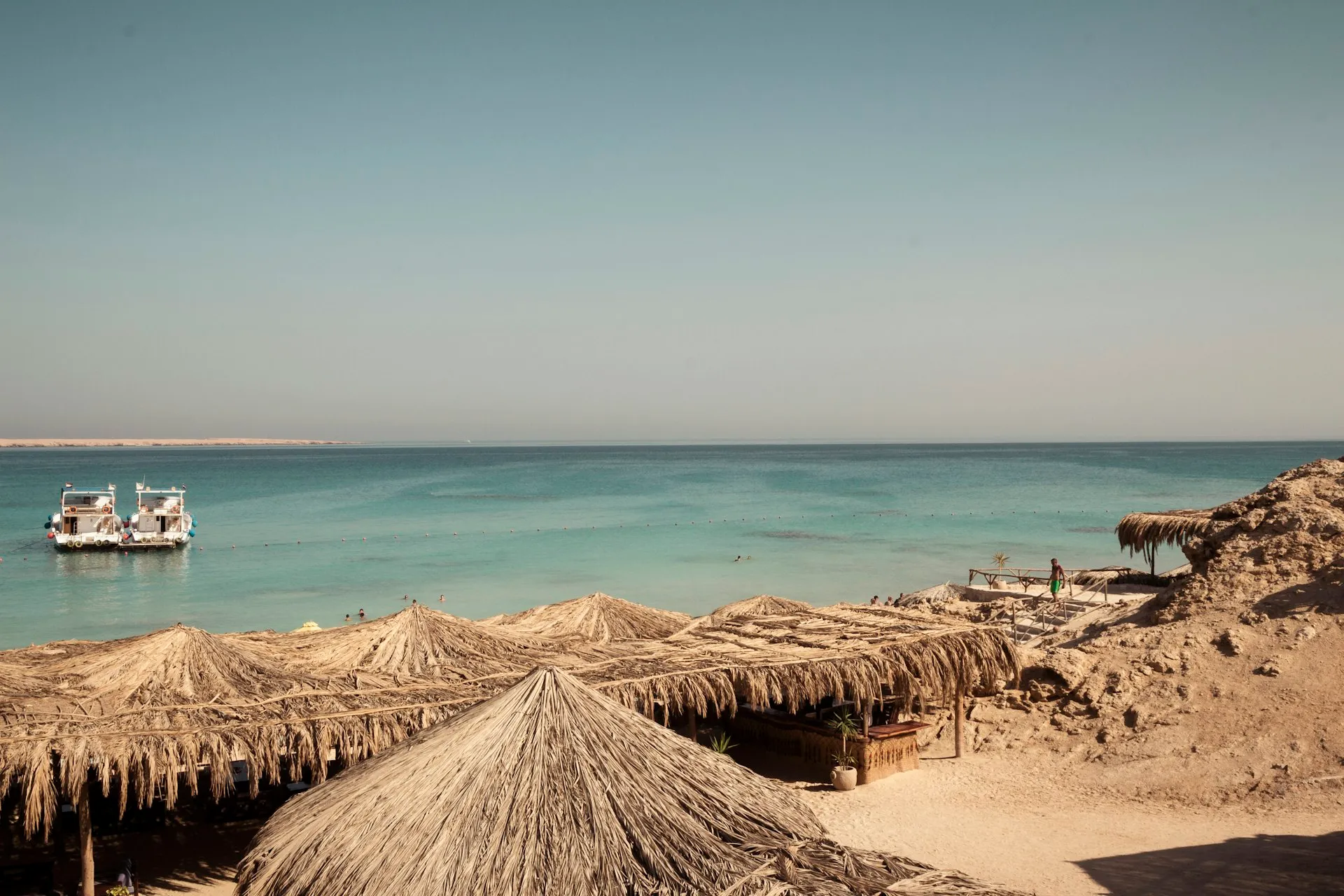
The Egyptian Red Sea is most comfortable for a yacht charter in October and November, and again from March to early May. In those months the daytime high at Hurghada runs from about 26 to 32C, the sea is warm enough to stay in, and the wind, which blows from the north-north-west all year, is at or near its lightest. June to September is the windiest part of the year and the hottest, with average highs of 36 to 37C. December to February is quiet and reliably sunny but cool, with the sea at about 22 to 23C and nights near 12C.
No month here is flat calm in the way a Maldivian lagoon is. The Red Sea is a windy sea, and the best months are the ones where the wind is moderate and the heat is kind. The rest of this guide sets out the figures behind that answer.
Which Red Sea this guide covers
Our Red Sea destination page describes the Egyptian coast: voyages based on Hurghada, the reefs and wrecks of the Strait of Gubal including the SS Thistlegorm, and Ras Mohammed at the southern tip of Sinai. That is the area the month table describes. Air temperatures are for Hurghada Airport and sea temperatures are for Hurghada.
We touch on the far south of Egypt, around Marsa Alam, because conditions there differ in useful ways. We do not cover the Saudi coast or Sudan.
The wind: north-north-westerly, all year
The Red Sea is a long, narrow basin with mountains on both sides, and those mountains steer the wind along its length. A Woods Hole study of ten years of satellite wind data states that over the northern Red Sea, north of about 20 degrees latitude, the winds along the axis blow southward all year round. Hurghada sits at 27 degrees north, well inside that zone. Windfinder’s long-running record for Hurghada Airport gives an average direction of north-north-west and an average speed of 12 knots, with average gusts of 22 knots.
The strength changes with the season, though less than in most cruising grounds. Monthly averages for Hurghada published by Climates to Travel run from about 19 km/h (10 to 11 knots) in November, December and January to about 25 km/h (13 to 14 knots) in June, with July, August and September close behind. Put plainly: the wind is lightest from October to January and freshest from June to September.
Three qualifications matter on a yacht.
Averages hide the afternoon. Those figures are day-and-night means at an airport. The gust figure above is nearer to what a breezy afternoon in open water feels like.
Winter has its own strong spells. The same Woods Hole study describes winter events in which cold, dry air pours westward off the Arabian desert through gaps in the mountains and across the northern Red Sea. They are typical of December and January. The satellite record showed 18 large events in ten years, each lasting three to eight days, with winds from roughly 3 to 10 metres per second (about 6 to 19 knots). So the lightest months on average still bring the occasional cool, blustery week.
Spring can bring dust. Climates to Travel describes the khamsin, a hot, dry wind that raises dust, as blowing mainly between March and May.
In practice a Red Sea itinerary is planned around shelter: nights in the lee of reefs and islands, longer passages early in the day, and routes that run with the wind where they can.
Heat on deck
Air temperature is the larger constraint on comfort. The 1991 to 2020 climate normals for Hurghada Airport give these average daily highs: 22C in January, 26C in March, 30C in April, 34C in May, 36C in June, 37C in July and August, 35C in September, 32C in October, 28C in November and 24C in December. Sharm el-Sheikh, across the strait in Sinai, runs about a degree hotter in summer, with 38C in July and August.
Those are averages. Climates to Travel notes that the temperature sometimes exceeds 40C, with peaks of 45C. Summer nights offer little relief: the average minimum at Hurghada in July and August is 28C.
On a yacht, that shapes the day. From June to September, time on deck is for early morning and the hour before sunset, and the middle of the day is spent in the water, in shade or in air conditioning. Sleep depends on the yacht’s cooling. Our guide to sleep at sea explains why night temperature matters as much as it does.
From October to April the pattern reverses. Midday is the pleasant part of the day, and in December and January the evenings call for a layer: the average night-time low at Hurghada is 13C in December and under 12C in January.
Rain is not a consideration. Hurghada averages under 8 mm in a whole year.
Sea temperature, swimming and diving
SeaTemperature.info, which compiles satellite and in-situ readings over the past ten years, gives these monthly averages for Hurghada: about 22C in February and March, 23C in April, 25C in May, 27C in June, 28C in July, 29C in August, 28C in September, 27C in October, 26C in November, 25C in December and 23C in January. Climates to Travel’s table runs about a degree cooler in winter, with 21C in February and March.
Either way, the sea is never truly cold. But 22C is cool for a long, still snorkel over a reef, and most people will want a wetsuit for anything more than a short swim between December and April. From May to November the water is comfortable for hours at a time.
On diving conditions we can say only what our sources support. Dive The World, a dive travel agency, gives underwater visibility in the Egyptian Red Sea as 20 to 30 metres throughout the year, with the north typically clearer than the south, and does not describe a strong seasonal swing. It suggests March to May and September to November as the best months for the northern sites, and June to September as the prime period for the far south, where summer is associated with sightings of larger open-water species. We have not found month-by-month visibility measurements from a scientific source, so treat those as an operator’s judgement.
For guests who come for the reefs, the Red Sea is the natural home of an active wellness voyage: diving, snorkelling and long days in the water, with empty desert behind the anchorage.
North and south compared
| Southern Sinai | Hurghada and the Strait of Gubal | Marsa Alam and the far south | |
|---|---|---|---|
| Typical sites | Ras Mohammed, Sharm el-Sheikh | Reefs off Hurghada, SS Thistlegorm | Remote reefs on longer passages |
| Average high in July | 38C (Sharm el-Sheikh) | 37C (Hurghada) | No official normals in our sources |
| Sea in March | About 23C | About 22C | About 23C |
| Sea in August | About 29 to 30C | About 29C | About 30C |
| Best diving months, per Dive The World | March to May, September to November | March to May, September to November | June to September |
| Currents, per Dive The World | Gentle to moderate | Gentle to moderate | Moderate to strong |
| Suits | Short passages, wall dives, a first visit | Wrecks and shorter passages | Experienced divers, longer voyages |
The differences in temperature are smaller than the distances suggest: about a degree of sea temperature separates Hurghada from Marsa Alam in most months. The real difference is exposure and remoteness. The south involves longer open-water passages and stronger currents, which is its appeal for some guests and a reason for others to stay north.
January and February
Cool, clear and quiet. Highs of 22 to 23C, nights near 12C, and the sea at its annual low of about 22 to 23C. Average wind is light for the Red Sea, but this is the season of the cold easterly spells described above. These months suit guests who want sun, silence and walking weather more than hours in the water. Bring warm layers for the evenings; our packing guide covers what a cool-season voyage needs.
March and April
The first of the two comfortable windows. Highs climb from 26C to 30C, which is ideal on deck. The sea lags behind at 22 to 23C, so diving and snorkelling are done in wetsuits. Dust-laden khamsin days are possible. Dive The World counts spring among the quieter periods for visitors.
May
A month of two halves. The average high is 34C, the sea reaches about 25C, and the wind begins to build towards its summer strength. The early weeks belong with April. By the end of the month, midday on deck is hot.
June to September
The windiest and hottest stretch of the year. Average wind peaks in June, highs sit at 36 to 37C from June to August, and nights stay near 28C in July and August. The sea reaches 28 to 29C, which makes the water the most comfortable place to be. Dive The World describes summer as the busier season, particularly in the north. It is also the season its guide recommends for the far south.
A summer voyage can work for keen divers who plan around early starts. For a restful week on deck, we would look elsewhere in summer. Our Turkey month-by-month guide describes a coast that is in season at exactly this time.
October and November
The second comfortable window, and the one we would choose first. The sea is still 26 to 27C, so swimming needs no thought. Highs ease from 32C to 28C. Average wind falls to its lowest of the year in November.
December
Much like January with slightly warmer water, about 25C. Highs of 24C, nights of 13C, and short days. A quiet month outside the holiday weeks.
Ramadan and other timing considerations
Egypt is a Muslim-majority country and Ramadan affects daily rhythm ashore. The UK government’s travel advice for Egypt notes that the dates vary by year and country and should be checked before you travel, and that during Ramadan it is culturally insensitive to eat, drink or smoke in public during daylight hours. Ramadan follows the lunar calendar, so it falls at a different point in the season each year. We have deliberately not listed dates here; your broker will confirm them for your year.
Life aboard a private yacht is largely unaffected, but shore visits, restaurant hours and provisioning may run to a different timetable, and some crew will be fasting. A good captain plans for this. If you are new to chartering, our first charter guide explains how provisioning and itineraries are agreed in advance.
Check current travel advice before booking
Before committing to dates, read your own government’s current travel advice for Egypt. For British travellers that is the Foreign, Commonwealth and Development Office page for Egypt on GOV.UK. Advice can differ between parts of the country and can change at short notice, and the FCDO states that travel insurance could be invalidated if you travel against its advice.
The same page carries specific guidance on boats and diving. It says that safety standards of Red Sea diving operators and boats vary considerably, recommends booking through reputable vendors who can give assurance about the standards that apply to the vessel, and suggests asking the crew for a thorough safety briefing before departure. It also reminds divers not to exceed the depth limit of their insurance policy. Ask your broker how the yacht you are considering is flagged, inspected and insured.
Which months suit a restorative voyage
- For warm water, moderate wind and gentle heat: mid-October to the end of November.
- For the best temperatures on deck: late March and April, accepting a cooler sea.
- For sun and solitude in the northern winter: December to February, with a wetsuit and a warm layer.
- For the far south and its summer diving: June to September, for experienced divers who accept the heat and wind.
If a truly still sea matters most, the Maldives in the first months of the year are a different proposition, set out in our Maldives month-by-month guide. If the Red Sea is the one, the Voyage Designer is a good place to begin shaping the week.
How we rate calm
The 1 to 5 calm rating in the month table is our editorial reading of typical wind and sea state for a guest at anchor and under way. It is not a forecast. No month scores 5, because the northerly wind blows throughout the year. October and November score 4: average wind is at its lowest and winter’s cold spells have not usually begun. June to September score 2, on the highest average wind speeds. The remaining months score 3. The spread in the underlying averages is modest, about 10 to 14 knots, so the differences between months are of degree.
Air temperatures in the table are 1991 to 2020 average daily highs at Hurghada Airport, and sea temperatures are ten-year monthly averages for Hurghada from SeaTemperature.info, all rounded to the nearest degree. Crowd ratings are the least certain column. They rest on one operator’s general description of busier summers and quieter winters, not on visitor statistics.
Conditions vary from year to year and from one reef to the next; treat these as typical patterns, not promises. If you would like to talk through dates for a Red Sea voyage, tell us what you are looking for.